Reading for Today's Lecture: Chapter 1 of Casella and Berger.
Goals of Today's Lecture:
Course outline:
Standard view of scientific inference has a set of theories which make predictions about the outcomes of an experiment:
| Theory | Prediction |
| A | 1 |
| B | 2 |
| C | 3 |
Conduct experiment, see outcome 2: we infer that Theory B is correct (or at least that A and C are wrong).
Add Randomness
| Theory | Prediction |
| A | Usually 1 sometimes 2 never 3 |
| B | Usually 2 sometimes 1 never 3 |
| C | Usually 3 sometimes 1 never 2 |
See outcome 2: infer Theory B probably correct, Theory A probably not correct, Theory C is wrong.
Probability Theory: construct table: compute likely outcomes of experiments.
Statistics: inverse process. Use table to draw inferences from outcome of experiment. How should we do it and how wrong are our inferences likely to be?
Probability Space (or Sample Space): ordered
triple
 .
.
 is a set (possible outcomes).
 is a family of subsets (events) of
with the property that
is a
is a family of subsets (events) of
with the property that
is a
 -field (or Borel field or -algebra):
 and
are members of .
and
are members of .
 implies

 all in
implies
all in
implies
 .
.
,
range a subset of
[0,1] satisfying:
 and
and
 .
.
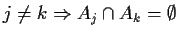
pairwise disjoint
(
 )
)
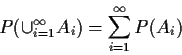
Axioms guarantee we can compute probabilities by usual rules, including approximation without fear of contradiction.
Vector valued random variable: function
 with the property that,
writing,
with the property that,
writing,
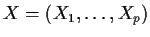

 .
Formally the notation
.
Formally the notation
 or event:
 so X1 is also a function on .
In almost all of probability and statistics the dependence of a random variable on
a point in the probability space is hidden! You almost always see X not  .
.
Now for formal definitions:
Borel -field in Rp: smallest -field in Rp
containing every open ball.
Every common set is a Borel set, that is, in the Borel -field.
An Rp valued random variable is a map
such that
when A is Borel then
 .
.
Fact: this is equivalent to

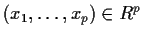 .
.
Jargon and notation: we write  for
for
 and define the distribution of X to be the map
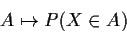 -field rather than
the original
and .
-field rather than
the original
and .
Cumulative Distribution Function (or CDF) of X: function FX on Rpdefined by

Properties of FX (or just F when there's only one CDF under consideration) for p=1:
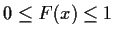 .
.
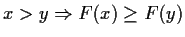 (F is monotone non-decreasing).
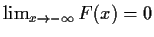
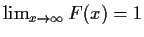
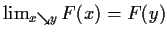 (F is right continuous).
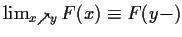 exists.
 for any (Borel) set A.
The distribution of a random variable X is discrete
(we also call the random variable discrete) if there
is a countable set
 such that

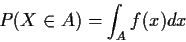
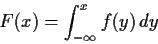
The distribution of a random variable X is absolutely continuous
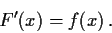
if there is a function f such that
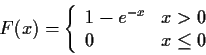
Example: X is exponential.
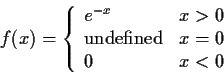
General Problem: Start with assumptions about the density or CDF of a random
vector
.
Define
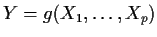 to be some function
of X (usually some statistic of interest). How can we compute the distribution
or CDF or density of Y?
to be some function
of X (usually some statistic of interest). How can we compute the distribution
or CDF or density of Y?
Univariate Techniques
Method 1: compute the CDF by integration and differentiate to find fY.
Example:
![$U \sim \mbox{Uniform}[0,1]$](img45.gif) and
and 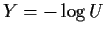 .
.
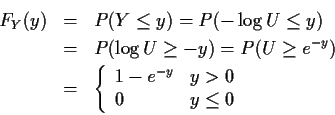
Example:
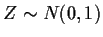 ,
i.e.
,
i.e.
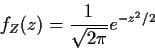


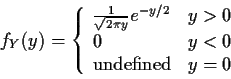
![\begin{displaymath}f_Y(y) = \left\{ \begin{array}{ll}
0 & y < 0
\\
\frac{d}{dy...
...\right] & y > 0
\\
\mbox{undefined} & y=0
\end{array}\right.
\end{displaymath}](img52.gif)
We will find indicator notation useful:
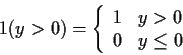
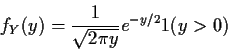
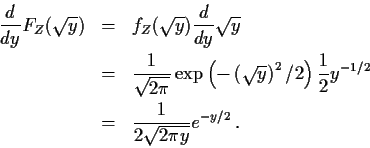
Notice: I never evaluated FY before differentiating it. In fact
FY and FZ are integrals I can't do but I can differentiate then anyway.
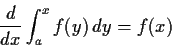
Remember fundamental theorem of calculus: