next up previous
Postscript version of this page

STAT 801: Mathematical Statistics

Independence, conditional distributions

So far density of $ X$ specified explicitly. Often modelling leads to a specification in terms of marginal and conditional distributions.


Def'n: Events $ A$ and $ B$ are independent if

$\displaystyle P(AB) = P(A)P(B) \, .
$

(Notation: $ AB$ is the event that both $ A$ and $ B$ happen, also written $ A\cap B$.)


Def'n: $ A_i$, $ i=1,\ldots,p$ are independent if

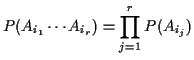
$\displaystyle P(A_{i_1} \cdots A_{i_r}) = \prod_{j=1}^r P(A_{i_j})
$

for any $ 1 \le i_1 < \cdots < i_r \le p$.


Example: $ p=3$

$\displaystyle P(A_1A_2A_3)$ $\displaystyle =$ $\displaystyle P(A_1)P(A_2)P(A_3)$  
$\displaystyle P(A_1A_2)$ $\displaystyle =$ $\displaystyle P(A_1)P(A_2)$  
$\displaystyle P(A_1A_3)$ $\displaystyle =$ $\displaystyle P(A_1)P(A_3)$  
$\displaystyle P(A_2A_3)$ $\displaystyle =$ $\displaystyle P(A_2)P(A_3)$  

All these equations needed for independence!

Example: Toss a coin twice.

$\displaystyle A_1$ $\displaystyle = \{$first toss is a Head$\displaystyle \}$    
$\displaystyle A_2$ $\displaystyle = \{$second toss is a Head$\displaystyle \}$    
$\displaystyle A_3$ $\displaystyle = \{$first toss and second toss different$\displaystyle \}$    

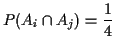
Then $ P(A_i) =1/2$ for each $ i$ and for $ i \neq j$

$\displaystyle P(A_i \cap A_j) = \frac{1}{4}
$

but

$\displaystyle P(A_1 \cap A_2 \cap A_3) = 0 \neq P(A_1)P(A_2)P(A_3) \, .
$

Def'n: $ X$ and $ Y$ are independent if

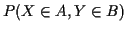
$\displaystyle P(X \in A; Y \in B) = P(X\in A)P(Y\in B)
$

for all $ A$ and $ B$.

Def'n: Rvs $ X_1,\ldots,X_p$ independent:

$\displaystyle P(X_1 \in A_1, \cdots , X_p \in A_p ) = \prod P(X_i \in A_i)
$

for any $ A_1,\ldots,A_p$.

Theorem:

  1. If $ X$ and $ Y$ are independent then for all $ x,y$

    $\displaystyle F_{X,Y}(x,y) = F_X(x)F_Y(y) \, .
$


  2. If $ X$ and $ Y$ are independent with joint density $ f_{X,Y}(x,y)$ then $ X$ and $ Y$ have densities $ f_X$ and $ f_Y$, and

    $\displaystyle f_{X,Y}(x,y) = f_X(x) f_Y(y) \, .
$


  3. If $ X$ and $ Y$ independent with marginal densities $ f_X$ and $ f_Y$ then $ (X,Y)$ has joint density

    $\displaystyle f_{X,Y}(x,y) = f_X(x) f_Y(y) \, .
$


  4. If $ F_{X,Y}(x,y) = F_X(x)F_Y(y)
$ for all $ x,y$ then $ X$ and $ Y$ are independent.


  5. If $ (X,Y)$ has density $ f(x,y)$ and there exist $ g(x)$ and $ h(y)$ st $ f(x,y) = g(x) h(y)
$ for (almost) all $ (x,y)$ then $ X$ and $ Y$ are independent with densities given by

    $\displaystyle f_X(x) = g(x)/\int_{-\infty}^\infty g(u) du
$

    $\displaystyle f_Y(y) = h(y)/\int_{-\infty}^\infty h(u) du \, .
$

Proof:

  1. Since $ X$ and $ Y$ are independent so are the events $ X \le x$ and $ Y \le y$; hence

    $\displaystyle P(X \le x, Y \le y) = P(X \le x)P(Y \le y) \, .
$

  2. Suppose $ X$ and $ Y$ real valued.

    Asst 2: existence of $ f_{X,Y}$ implies that of $ f_X$ and $ f_Y$ (marginal density formula). Then for any sets $ A$ and $ B$

    $\displaystyle P(X \in A, Y\in B)$ $\displaystyle = \int_A\int_B f_{X,Y}(x,y) dydx$    
    $\displaystyle P(X\in A)P(Y\in B)$ $\displaystyle = \int_A f_X(x)dx \int_B f_Y(y) dy$    
      $\displaystyle = \int_A\int_B f_X(x)f_Y(y) dydx \, .$    

    Since $ P(X \in A, Y\in B) =P(X\in A)P(Y\in B)$

    $\displaystyle \int_A\int_B [ f_{X,Y}(x,y) - f_X(x)f_Y(y) ]dydx = 0 \, .
$

    It follows (measure theory) that the quantity in [] is 0 (almost every pair $ (x,y)$).

  3. For any $ A$ and $ B$ we have

    $\displaystyle P(X \in A, Y \in$ $\displaystyle B)$    
      $\displaystyle = P(X\in A)P(Y \in B)$    
      $\displaystyle = \int_A f_X(x)dx \int_B f_Y(y) dy$    
      $\displaystyle = \int_A\int_B f_X(x)f_Y(y) dydx \, .$    

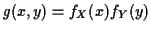
    If we define $ g(x,y) = f_X(x)f_Y(y) $ then we have proved that for $ C=A \times B$

    $\displaystyle P( (X,Y) \in C) = \int_C g(x,y)dy dx \, .
$

    To prove that $ g$ is $ f_{X,Y}$ we need only prove that this integral formula is valid for an arbitrary Borel set $ C$, not just a rectangle $ A \times B$.

    This is proved via a monotone class argument. The collection of sets $ C$ for which identity holds has closure properties which guarantee that this collection includes the Borel sets.

  4. Another monotone class argument.

  5. $\displaystyle P(X \in A, Y\in B)$ $\displaystyle = \int_A \int_B g(x) h(y) dy dx$    
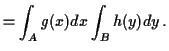
      $\displaystyle = \int_A g(x) dx \int_B h(y) dy \, .$    

    Take $ B=R^1$ to see that

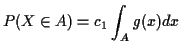
    $\displaystyle P(X \in A ) = c_1 \int_A g(x) dx
$

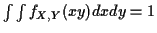
    where $ c_1 = \int h(y) dy$. So $ c_1 g$ is the density of $ X$. Since $ \int\int f_{X,Y}(xy)dxdy = 1$ we see that $ \int g(x) dx \int h(y) dy = 1$ so that $ c_1 = 1/\int g(x) dx$. Similar argument for $ Y$.

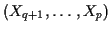
Theorem: If $ X_1,\ldots,X_p$ are independent and $ Y_i =g_i(X_i)$ then $ Y_1,\ldots,Y_p$ are independent. Moreover, $ (X_1,\ldots,X_q)$ and $ (X_{q+1},\ldots,X_{p})$ are independent.

Conditional probability

Def'n: $ P(A\vert B) = P(AB)/P(B)$ if $ P(B) \neq 0$.

Def'n: For discrete $ X$ and $ Y$ the conditional probability mass function of $ Y$ given $ X$ is

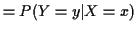
$\displaystyle f_{Y\vert X}(y\vert x)$ $\displaystyle = P(Y=y\vert X=x)$    
  $\displaystyle = f_{X,Y}(x,y)/f_X(x)$    
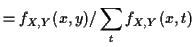
  $\displaystyle = f_{X,Y}(x,y)/\sum_t f_{X,Y}(x,t)$    

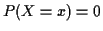
For absolutely continuous $ X$ $ P(X=x) = 0$ for all $ x$. What is $ P(A\vert X=x)$ or $ f_{Y\vert X}(y\vert x)$? Solution: use limit

$\displaystyle P(A\vert X=x) = \lim_{\delta x \to 0} P(A\vert x \le X \le x+\delta x)
$

If, e.g., $ X,Y$ have joint density $ f_{X,Y}$ then with $ A=\{ Y \le y\}$ we have

$\displaystyle P(A\vert x \le X$ $\displaystyle \le x+\delta x)$    
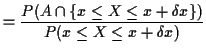
  $\displaystyle = \frac{P(A \cap \{ x \le X \le x+\delta x\} ) }{P(x \le X \le x+\delta x)}$    
  $\displaystyle = \frac{ \int_{-\infty}^y \int_x^{x+\delta x} f_{X,Y}(u,v)dudv }{ \int_x^{x+\delta x} f_X(u) du }$    

Divide top, bottom by $ \delta x$; let $ \delta x \to 0$. Denom converges to $ f_X(x)$; numerator converges to

$\displaystyle \int_{-\infty}^y f_{X,Y}(x,v) dv
$

Define conditional cdf of $ Y$ given $ X=x$:

$\displaystyle P(Y \le y \vert X=x) = \frac{
\int_{-\infty}^y f_{X,Y}(x,v) dv
}{
f_X(x)
}
$

Differentiate wrt $ y$ to get def'n of conditional density of $ Y$ given $ X=x$:

$\displaystyle f_{Y\vert X}(y\vert x) = f_{X,Y}(x,y)/f_X(x) \, ;
$

in words ``conditional = joint/marginal''.

next up previous


Richard Lockhart
2001-01-05