


Theorem:
Suppose
 are independent
 random
variables.
Then
random
variables.
Then
 (sample mean)and
  (sample variance) independent.
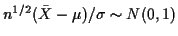 .
.
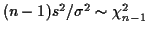 .
.
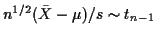 .
.
Proof: Let
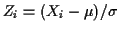 .
.
Then
 are
independent
are
independent  .
.
So
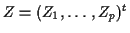 is multivariate
standard normal.
is multivariate
standard normal.
Note that
 and
and
 Thus
Thus
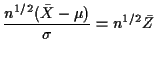
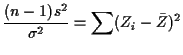
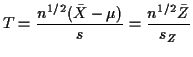
 .
.
So: reduced to  and
and  .
.
Step 1: Define

 has same dimension as
  .) Now
![$\displaystyle Y =\left[\begin{array}{cccc}
\frac{1}{\sqrt{n}} &
\frac{1}{\sqrt{...
...]
\left[\begin{array}{c}
Z_1 \\
Z_2 \\
\vdots
\\
Z_n
\end{array}\right]
$](img23.gif)
 denote the matrix

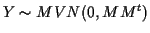 so we need
to compute
so we need
to compute
 :
:
 |
![$\displaystyle = \left[\begin{array}{c\vert cccc} 1 & 0 & 0 & \cdots & 0 \\ \hli...
...ots & -\frac{1}{n} \\ 0 & \vdots & \cdots & & 1-\frac{1}{n} \end{array} \right]$](img29.gif) |
|
![$\displaystyle = \left[\begin{array}{c\vert c} 1 & 0 \\ \hline \\ 0 & Q \end{array} \right] \, .$](img30.gif) |
Solve for from :
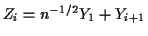 for
for
 . Use the identity
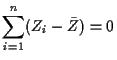
 . So
invertible:
. So
invertible:
![$\displaystyle \Sigma^{-1} \equiv (MM^t)^{-1} =
\left[\begin{array}{c\vert c}
1 & 0
\\
\hline
\\
0 & Q^{-1}
\end{array}\right]
$](img35.gif)
Use change of variables to find  .
Let
.
Let
 denote vector whose
entries are
denote vector whose
entries are
 . Note that
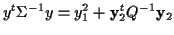
 |
![$\displaystyle (2\pi)^{-n/2} \exp[-y^t\Sigma^{-1}y/2]/\vert\det M\vert$](img41.gif) |
|
 |
 |
|
![$\displaystyle \frac{(2\pi)^{-(n-1)/2}\exp[-{\bf y}_2^t Q^{-1} {\bf y}_2/2]}{\vert\det M\vert}$](img44.gif) |
Note:  is ftn of
  times a
ftn of
.
times a
ftn of
.
Thus
 is independent of
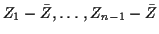 .
.
Since  is a function of
we see that
and
are independent.
is a function of
we see that
and
are independent.
Also, density of  is a multiple of the function of in
the factorization above. But factor is standard normal
density so
is a multiple of the function of in
the factorization above. But factor is standard normal
density so
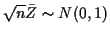 .
.
First 2 parts done. Third part is a homework exercise.
Derivation of the  density:
Suppose
 are independent . Define
 distribution to be that of
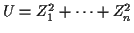 .
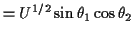
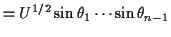
Define angles
.
Define angles
 by
by
 |
 |
|
 |
 |
|
 |
 |
|
 |
 |
|
 |
 |
 dimensions. The
  values run
from 0 to
values run
from 0 to  except last from 0 to
  .)
Derivative formulas:
.)
Derivative formulas:

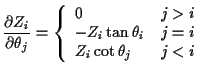
Fix  to clarify the formulas.
Use shorthand
 .
.
Matrix of partial derivatives is
![$\displaystyle \left[\begin{array}{ccc}
\frac{\cos\theta_1}{2R}
&
-R \sin\theta_...
...R}
&
R cos\theta_1\sin\theta_2
&
R \sin\theta_1\cos\theta_2
\end{array}\right]
$](img75.gif)
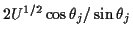 times col 1 to col
 (no change in determinant).
Resulting matrix is lower triangular; diagonal entries
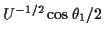 ,
,
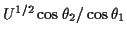 and
and
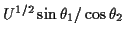 .
.
We multiply these together to get
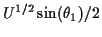
 and
and  ).
).
General : every term in the first column contains a factor
 while
every other entry has a factor
while
every other entry has a factor  .
.
FACT: Multiplying a column in a matrix by  multiplies
the determinant by .
multiplies
the determinant by .
SO: Jacobian of the transformation is
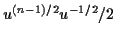 times
some function, say
times
some function, say  , which depends only on the angles.
Thus the joint density
of
 is
is
 we must do an
  dimensional
multiple integral
dimensional
multiple integral
 .
.
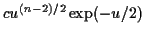
Answer has the form
 .
.
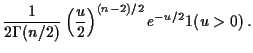
Evaluate by making

 ,
,  to see that
 density is
Fourth part: consequence of
first 3 parts and def'n of  distribution.
Defn:
 if
if  has same distribution
as
has same distribution
as

 ,
,
 and and are independent.
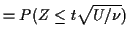
Derive density of in this definition:
 |
 |
|
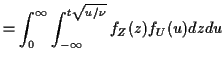 |
 by
differentiating inner integral:
by
differentiating inner integral:
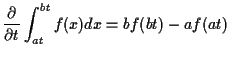
![$\displaystyle \frac{d}{dt} P(T \le t) =
\int_0^\infty f_U(u)
\left(\frac{u}{\nu}\right)^{1/2}
\frac{\exp[-t^2u/(2\nu)]}{\sqrt{2\pi}} du
$](img110.gif)
Plug in

![$\displaystyle f_T(t) = \frac{\int_0^\infty (u/2)^{(\nu-1)/2}
\exp[-u(1+t^2/\nu)/2]du
}{2\sqrt{\pi\nu}\Gamma(\nu/2)} \, .
$](img112.gif)
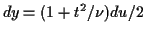
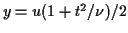 , to get
![$\displaystyle (u/2)^{(\nu-1)/2}= [y/(1+t^2/\nu)]^{(\nu-1)/2}$](img115.gif)

