Probability Space (or Sample Space): ordered
triple
 .
.
 is a set (possible outcomes); elements are
  called
elementary outcomes.
called
elementary outcomes.
 is a family of subsets ( events) of with the property that is a
 -field (or Borel field or -algebra):
 and are members of .
 implies

 all in implies
 .
. a function, domain , range a subset of
![$ [0,1]$](img12.gif) satisfying:
satisfying:
 and
and
 .
.
pairwise disjoint
(
 )
)
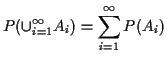
Axioms guarantee can compute probabilities by usual rules, including approximation.
Consequences of axioms:
 implies
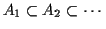 all in $F$ implies
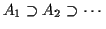 all in $F$ implies
Vector valued random variable: function
 such that,
writing
such that,
writing
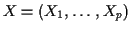 ,
,

 .
Formally the notation
.
Formally the notation
 or event:

 is a function on so
  is also a function on .
In almost all of probability and statistics the dependence of a random variable on
a point in the probability space is hidden! You almost always see not  .
.
Borel -field in  : smallest -field in
containing every open ball.
: smallest -field in
containing every open ball.
Every common set is a Borel set, that is, in the Borel -field.
An valued random variable is a map
such that
when  is Borel then
 .
.
Fact: this is equivalent to

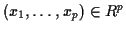 .
.
Jargon and notation: we write  for
for
 and define the distribution of to be the map
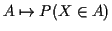 with the Borel -field rather than
the original and .
with the Borel -field rather than
the original and .
Cumulative Distribution Function (CDF) of : function  on
defined by
on
defined by
 (usually just
  ) for
) for  :
:
 .
.
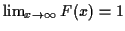
 (monotone non-decreasing).
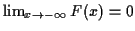 and
and
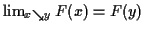 (right continuous).
 exists.
 .
.
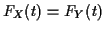 for all
  implies that and
  have the
same distribution, that is,
have the
same distribution, that is,
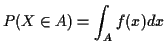
 for any (Borel) set .
The distribution of a random variable is discrete
(we also call the random variable discrete) if there
is a countable set
 such that
 is
is
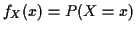
Distribution of rv is absolutely continuous
if there is a function  such that
.
This is a  dimensional integral in general. Equivalently
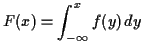 satisfying (0.1) is a
density of .
satisfying (0.1) is a
density of .
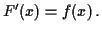
For most values of  we then have
is differentiable at and
we then have
is differentiable at and
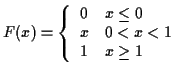
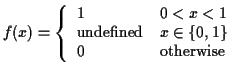
Example: is Uniform[0,1].
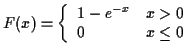
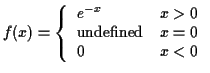
Example: is exponential.