


Reading for Today's Lecture:
Goals of Today's Lecture:
Today's notes
 of possible ``states of nature''.
 which is the loss I incur if I do d and
 is the true state of nature.
 minimax if
 on ,.
on ,.
 for a prior
is
the
integral is a sum.
for a prior
is
the
integral is a sum.
is Bayes for a prior
if
 .
.
 .
A positive function on
is called
a proper prior if it has a finite integral; in this case we divide through
by that integral to get a density. A positive function on
whose
integral is infinite is an improper prior density.
.
A positive function on
is called
a proper prior if it has a finite integral; in this case we divide through
by that integral to get a density. A positive function on
whose
integral is infinite is an improper prior density.
is inadmissible if there is
a decision
such that
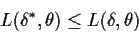 and there is at least one value of
where the
inequality is strict. A decision which is not inadmissible is called
admissible.
and there is at least one value of
where the
inequality is strict. A decision which is not inadmissible is called
admissible.
)
is admissible. (Proof: If
is
Bayes for
but not admissible there is a
such that
for which the inequality involving L is
strict and if the density of
is positive at that
then
the inequality for  is strict which would contradict the hypothesis
that
is Bayes for .
Notice that this theorem actually
requires the extra hypothesis about the positive density and that the
risk functions of
and
be continuous.)
is strict which would contradict the hypothesis
that
is Bayes for .
Notice that this theorem actually
requires the extra hypothesis about the positive density and that the
risk functions of
and
be continuous.)
and its risk is constant on
the set of
for which the prior density is positive.
Statistical problems have another ingredient, the data. We observe
X a random variable taking values in say  .
We may make our decision d depend on X. A
decision rule is a function
.
We may make our decision d depend on X. A
decision rule is a function  from
to D.
We will want
from
to D.
We will want
 to be small for all .
Since
X is random we quantify this by averaging over X and compare procedures
in terms of the risk function
to be small for all .
Since
X is random we quantify this by averaging over X and compare procedures
in terms of the risk function

To compare two procedures we must compare two functions of
and
pick ``the smaller one''. But typically the two functions will cross each
other and there won't be a unique `smaller one'.
Example: In estimation theory to estimate a real parameter
we used  ,
,
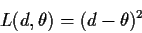
 is
is
![\begin{displaymath}R_{\hat\theta}(\theta) = E[(\hat\theta-\theta)^2]
\end{displaymath}](img22.gif)
 .
We have already seen that there is no unique best estimator in
the sense of MSE. How do we compare risk functions in general? We
extend minimax and bayes to risks rather than just losses.
.
We have already seen that there is no unique best estimator in
the sense of MSE. How do we compare risk functions in general? We
extend minimax and bayes to risks rather than just losses.
to minimize the worst case
risk:
 minimax if

 for
for  and
and  for
for  .
This is the source of ``minimax''.
.
This is the source of ``minimax''.
to minimize an average
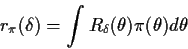 .
We call
a prior density
and r the Bayes risk of
for the prior .
.
We call
a prior density
and r the Bayes risk of
for the prior .
Definition: A decision rule
is inadmissible if there is
a rule
such that
 and there is at least one value of
where the
inequality is strict. A rule which is not inadmissible is called admissible.
and there is at least one value of
where the
inequality is strict. A rule which is not inadmissible is called admissible.
Now let's focus on the problem of estimation of a 1 dimensional
parameter. Mean Squared Error
corresponds to using
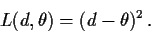
The risk function of a procedure (estimator)
is
![\begin{displaymath}R_{\hat\theta}(\theta) =E_\theta[(\hat\theta-\theta)^2 ]
\end{displaymath}](img33.gif)
 .
The
Bayes risk of
is
.
The
Bayes risk of
is

How should we choose
to minimize ? The solution
lies in recognizing that
 is really a joint
density
is really a joint
density
is just the model
 .
From now on I write the model as
.
From now on I write the model as
 to emphasize this fact. We can now compute
a different way by factoring the joint density a different way:
to emphasize this fact. We can now compute
a different way by factoring the joint density a different way:

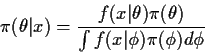
 denotes the conditional density of
given X. We call
the posterior density. It is found via
Bayes theorem (which is why this is Bayesian statistics):
denotes the conditional density of
given X. We call
the posterior density. It is found via
Bayes theorem (which is why this is Bayesian statistics):
With this notation we can write
![\begin{displaymath}r_\pi(\hat\theta) = \int \left[ \int (\hat\theta(x) - \theta)^2
\pi(\theta\vert x) d\theta \right] f(x) dx
\end{displaymath}](img43.gif)
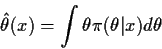
 separately for each x to minimize the
quantity in square brackets (as in the NP lemma). The quantity in
square brackets is a quadratic function of
and can be seen
to be minimized by
separately for each x to minimize the
quantity in square brackets (as in the NP lemma). The quantity in
square brackets is a quadratic function of
and can be seen
to be minimized by
 .
.
Example: Consider first the problem of estimating a normal
mean  .
Imagine, for example that
is the true speed of sound.
I think this is around 330 metres per second and am pretty sure that I
am within 30 metres per second of the truth with that guess. I might
summarize my opinion by saying that I think
has a normal distribution
with mean
.
Imagine, for example that
is the true speed of sound.
I think this is around 330 metres per second and am pretty sure that I
am within 30 metres per second of the truth with that guess. I might
summarize my opinion by saying that I think
has a normal distribution
with mean  330 and standard deviation
  .
That is, I take a
prior density
for
to be
.
Before I make any
measurements my best guess of
minimizes
.
That is, I take a
prior density
for
to be
.
Before I make any
measurements my best guess of
minimizes
 ,
namely,
,
namely,

Now suppose we collect 25 measurements of the speed of sound. I will
assume that the relationship between the measurements and
is that
the measurements are unbiased and that the standard deviation of the
measurement errors is  which I assume that we know. Thus the
model is that conditional on
which I assume that we know. Thus the
model is that conditional on
 are iid
 .
The joint density of the data and
is then
.
The joint density of the data and
is then
 so the conditional distribution of
given
is
normal. Standard multivariate normal formulas can be used to calculate
the conditional means and variances. Alternatively the exponent in the
joint density is of the form
so the conditional distribution of
given
is
normal. Standard multivariate normal formulas can be used to calculate
the conditional means and variances. Alternatively the exponent in the
joint density is of the form
![\begin{displaymath}-\frac{1}{2} \left[ \mu^2 /\gamma^2 - 2 \mu \psi/\gamma^2\right]
\end{displaymath}](img58.gif) where
where

 given the data is
 .
In other words the posterior mean of
is
.
In other words the posterior mean of
is

 and the sample
mean
and the sample
mean  .
Notice that the weight on the data is large when n
is large or
.
Notice that the weight on the data is large when n
is large or  is small (precise measurements) and small when
 is small (precise prior opinion).
Improper priors: When the density does not integrate
to 1 we can still follow the machinery of Bayes' formula to derive
a posterior. For instance in the
example consider
the prior density
 .
This ``density'' integrates
to
but using Bayes' theorem to compute the posterior would
give
.
This ``density'' integrates
to
but using Bayes' theorem to compute the posterior would
give

 giving a
 density.
That is, the Bayes estimate of
for this improper prior is .
density.
That is, the Bayes estimate of
for this improper prior is .
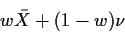
Admissibility: ayes procedures for proper priors are
admissible. It follows that for each
 and each real
the estimate
and each real
the estimate
 is admissible is much harder to prove.
Minimax estimation: The risk function of
is simply
 .
That is, the risk function is constant since
it does not depend on .
Were
Bayes for a proper
prior this would prove that
is minimax. In fact this is also
true but hard to prove.
.
That is, the risk function is constant since
it does not depend on .
Were
Bayes for a proper
prior this would prove that
is minimax. In fact this is also
true but hard to prove.
Example: Suppose that given p X has a Binomial(n,p)
distribution. We will give p a Beta
 prior density

 density. The mean of a Beta
distribution is
density. The mean of a Beta
distribution is
 .
Thus the Bayes estimate
of p is
.
Thus the Bayes estimate
of p is

 is the usual mle.
Notice that this is again a weighted average of the prior mean and
the mle. Notice also that the prior is proper for
is the usual mle.
Notice that this is again a weighted average of the prior mean and
the mle. Notice also that the prior is proper for  and
and
 .
To get w=1 we take
.
To get w=1 we take
 and use the improper
prior
and use the improper
prior

 is admissible for
.
Again it is true that
is admissible for
.
Again it is true that  is admissible but that
our theorem is not adequate to prove this fact.
is admissible but that
our theorem is not adequate to prove this fact.
The risk function of
 is
is
![\begin{displaymath}R(p) = E[(w\hat{p} +(1-w) p_0-p)^2]
\end{displaymath}](img89.gif)

 .
Moreover the equation
.
Moreover the equation
 .
The minimax estimate of
p is
.
The minimax estimate of
p is
Example: Now suppose that
are iid
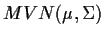 with
with  known. Consider as the improper prior for
which is constant. The
posterior density of
given X is then
known. Consider as the improper prior for
which is constant. The
posterior density of
given X is then
 .
.
For multivariate estimation it is common to extend the notion of squared error loss
by defining
 is Bayes for an improper
prior in this problem. It turns out that
is minimax; its risk function is
the constant
is Bayes for an improper
prior in this problem. It turns out that
is minimax; its risk function is
the constant
 .
If the dimension p of
is 1 or 2 then
is also admissible but if
.
If the dimension p of
is 1 or 2 then
is also admissible but if  then it is inadmissible. This fact
was first demonstrated by James and Stein who produced an estimate which is better,
in terms of this risk function, for every .
The ``improved'' estimator, called the
James Stein estimator is essentially never used.
then it is inadmissible. This fact
was first demonstrated by James and Stein who produced an estimate which is better,
in terms of this risk function, for every .
The ``improved'' estimator, called the
James Stein estimator is essentially never used.