


Model identification summary: The simplest model identification tactic is to look for either a pure MA or pure AR model. To do so:
 against
  . If the process is an
  then
the ACF will be 0 after lag
then
the ACF will be 0 after lag  .
.
 against . If the process is an
  then
the PACF will be 0 after lag
then
the PACF will be 0 after lag  .
.
If  is not stationary we will need to transform to find a
related stationary series. We will consider in this course
two sorts of non-stationarity -- non constant mean and integration.
is not stationary we will need to transform to find a
related stationary series. We will consider in this course
two sorts of non-stationarity -- non constant mean and integration.
Non constant mean: If
E is not constant we
will hope to model
is not constant we
will hope to model
 E using a small number of parameters
and then model
E using a small number of parameters
and then model
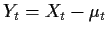 as a stationary series. Three common
structures for
as a stationary series. Three common
structures for  are linear, polynomial and periodic:
Linear trend: Suppose

 and
and  in order to analyze
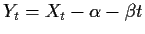 .
.
Method 1: regression (detrending). We regress
 on
on  to get
 and
and  and analyze
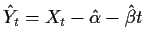

Method 2: differencing. Define
 |
 |
|
![$\displaystyle = \left[(I-B)X\right]_t$](img25.gif) |
 |
![$\displaystyle \left[(\alpha+\beta t +Y_t) - (\alpha+\beta (t-1) +Y_{t-1})\right]$](img27.gif) |
|
 |
 it is stationary if is. BUT, it might be stationary
even if is not. Suppose that
it is stationary if is. BUT, it might be stationary
even if is not. Suppose that
 is an iid mean 0
sequence. Then
is an iid mean 0
sequence. Then

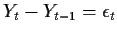 is stationary. To see that
  , the random walk, is not
stationary notice that
Var
, the random walk, is not
stationary notice that
Var Var
Var .
.
These random walk models are common in Economics. In physics they are used in the limit of very small time increments - this leads to Brownian motion.
Definition: satisfies an ARIMA model if
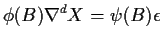
 is white noise,
 is a polynomial of degree ,
 is a polynomial of degree ,
 is the differencing operator.
Remark: If
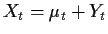 where is stationary
and
where is stationary
and  is a polynomial of degree
less than or equal to then
is a polynomial of degree
less than or equal to then
 is stationary.
(So a cubic shaped trend could be removed by differencing 3 times.)
is stationary.
(So a cubic shaped trend could be removed by differencing 3 times.)
WARNING: it is a common mistake in students' data analyses to over
difference. When you difference a stationary 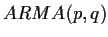 you
introduce a unit root in the defining polynomial - the result
cannot be written as an infinite order moving average.
you
introduce a unit root in the defining polynomial - the result
cannot be written as an infinite order moving average.
Detrending: Define a response vector
![$\displaystyle U = \left[\begin{array}{c} X_0 \\ \vdots \\ X_{T-1} \end{array} \right]
$](img46.gif)
![$\displaystyle V=\left[\begin{array}{cc} 1 & 0 \\ 1 & 1 \\ \vdots & \vdots \\ 1 & T-1
\end{array}\right]
$](img47.gif)

![$\displaystyle Y = \left[\begin{array}{c} Y_0 \\ \cdots \\ Y_{T-1} \end{array} \right]
$](img49.gif)
![$\displaystyle \theta = \left[\begin{array}{c} \alpha \\ \beta\end{array}\right] \, .
$](img50.gif)
 |
 |
|
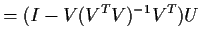 |
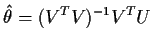
 ordinary least squares
is not strictly appropriate. In general in the model
ordinary least squares
is not strictly appropriate. In general in the model
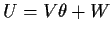
 has mean 0 and variance covariance matrix
  ,
the minimum variance linear estimator of
,
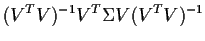
the minimum variance linear estimator of  is the generalized
least squares estimate
is the generalized
least squares estimate


The problem in our context (it is almost always a problem)
is that you can only use
 if you know
. In our context you won't know until you
have removed a trend, selected a suitable
if you know
. In our context you won't know until you
have removed a trend, selected a suitable  model and
estimated the parameters. The natural proposal is to follow
an iterative process:
model and
estimated the parameters. The natural proposal is to follow
an iterative process:
model.
The process is repeated until the estimates stop changing in any important way.
Folklore: There is evidence that the OLS estimator has a variance which is not too much different from GLS in common ARMA models.
Every winter the measured (not reported) unemployment rate in Canada rises. A simple model which has this feature has a non-stationary mean of the form

 is 12 for monthly data or 4 for quarterly
data (common in economic data). Normally,
is 12 for monthly data or 4 for quarterly
data (common in economic data). Normally,
 are
not the same, of course.
are
not the same, of course.
Definition: Deseasonalization is the process of transforming
to eliminate this sort of seasonal variation in the mean.
Method 1: Regression. Estimate
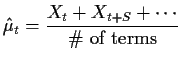
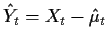
![$\displaystyle \theta = \left[\begin{array}{c} \mu_0 \\ \vdots \\ \mu_{S-1}
\end{array}\right]
$](img70.gif)
![$\displaystyle V=\left[\begin{array}{ccccc} 1 & 0 & 0 & \cdots & 0
\\
0 & 1 & ...
...\
\vdots & \vdots & \vdots & \vdots & \vdots
\end{array}\right]_{T \times S}
$](img71.gif)
Method B: Seasonal differencing:
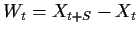 was an ARMA process then
now has a unit root.
was an ARMA process then
now has a unit root.
Definition: A multiplicative
 model has the form:

 are polynomials of degree
  respectively
with all roots outside the unit circle (and other technical conditions -
see assignment 2, question 1) and is white noise.
respectively
with all roots outside the unit circle (and other technical conditions -
see assignment 2, question 1) and is white noise.
As an example consider the model

 model. Multiplying this
out we get
model. Multiplying this
out we get

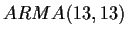 . The key point is that this new
model has only 4 parameters (plus the variance of )
instead of the 26 for a general
.
. The key point is that this new
model has only 4 parameters (plus the variance of )
instead of the 26 for a general
.
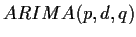 models to data
Fitting the  part is easy we simply difference
  times. The
same observation applies to seasonal multiplicative model. Thus
to fit an ARIMA model to you compute
times. The
same observation applies to seasonal multiplicative model. Thus
to fit an ARIMA model to you compute
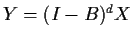 (shortening your data set by observations)
and then you fit an model to . So we assume that
(shortening your data set by observations)
and then you fit an model to . So we assume that
 .
.
Simplest case: fitting the AR(1) model

 and
and
 Var
Var .
.
Our basic strategy will be:
Generally the full likelihood is rather complicated; we will use conditional likelihoods and ad hoc estimates of some parameters to simplify the situation.
If the errors are normal then so is the series . In general
the vector
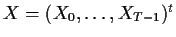 has a
has a
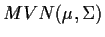 where
where
 and
and  is a vector all of whose entries are
. The joint density of is
is a vector all of whose entries are
. The joint density of is

![$\displaystyle \ell(\mu,a_1,\ldots,a_p,b_1,\ldots,b_q,\sigma) =
-\frac{1}{2}\left[
(x-{\bf\mu})^t \Sigma^{-1} (x-{\bf\mu}) + \log(\det(\Sigma))\right]
$](img95.gif) )
the parameters on which the quantity depends.
)
the parameters on which the quantity depends.
It is possible to carry out full maximum likelihood by maximizing the quantity in question numerically. In general this is hard, however.
Here I indicate some standard tactics. In your homework I will be asking you to carry through this analysis for one particular model.
 model
model
Consider the model
 in
a simpler way:
in
a simpler way:

![$\displaystyle f_{X_{k+1}\vert X_k,\ldots,X_0} (x_k\vert x_{k-1},\ldots,x_{0}) =
g\left[x_k-\mu-\rho(x_{k-1}-\mu)\right]
$](img99.gif)
 is the density of an individual . For iid
 errors this gives
a log likelihood which is
errors this gives
a log likelihood which is
![$\displaystyle \ell(\mu,\rho,\sigma) = - \frac{1}{2\sigma^2}\sum_1^{T-1} \left[x_k-\mu-\rho(x_{k-1}-\mu)\right]^2
-(T-1)\log(\sigma) + \log(f_{X_0})
$](img102.gif)
 so that

 |
![$\displaystyle = - \frac{1}{2\sigma^2} \left\{ \sum_1^{T-1}\left[x_k-\mu-\rho(x_{k-1}-\mu)\right]^2 +(1-\rho^2)(x_0-\mu)^2\right\}$](img106.gif) |
|
 |
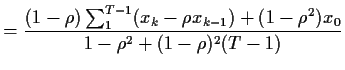
and  explicitly. First

+ (1-\rho^2)(x_0-\mu)\right\}
$](img109.gif)
 |
 |
|
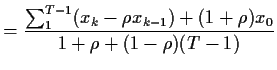 |
and that if  is large we may drop the 1
in the denominator and the term involving
is large we may drop the 1
in the denominator and the term involving  in the denominator and get
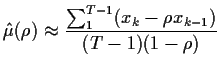


Now compute
![$\displaystyle \frac{\partial}{\partial\sigma} \ell = \frac{1}{\sigma^3}\left\{
...
...mu-\rho(x_{k-1}-\mu)\right]^2 +(1-\rho^2)(x_0-\mu)^2\right\}
-\frac{T}{\sigma}
$](img118.gif)
![$\displaystyle \hat\sigma^2(\rho) = \frac{\left\{
\sum_1^{T-1}\left[x_k-\mu(\rho)-\rho(x_{k-1}-\mu(\rho))\right]^2
+(1-\rho^2)(x_0-\mu(\rho))^2\right\}}{T}
$](img119.gif)
 is known it is easy to check that
 maximizes
 .
.
To find  you now plug
 and
and
 into
into  (getting the so called profile likelihood
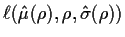 )
and maximize over . Having thus found the mles of and
)
and maximize over . Having thus found the mles of and
 are simply
 and
and
 .
.
It is worth observing that fitted residuals can then be calculated:

 of them since you cannot easily estimate
 .) Note, too, that the formula for
 simplifies to
