
Chapter Contents

Previous

Next
|
Chapter Contents |
Previous |
Next |
| The CALIS Procedure |
| Option |
Short Description |
| Estimation Methods | |
| G4=i | algorithm for computing STDERR |
| Optimization Techniques | |
| TECHNIQUE=name | minimization method |
| UPDATE=name | update technique |
| LINESEARCH=i | line-search method |
| FCONV=r | relative change function convergence criterion |
| GCONV=r | relative gradient convergence criterion |
| INSTEP=r | initial step length (SALPHA=, RADIUS=) |
| LSPRECISION=r | line-search precision |
| MAXFUNC=i | maximum number of function calls |
| MAXITER=i <n> | maximum number of iterations |
| Miscellaneous Options | |
| ASINGULAR=r | absolute singularity criterion for inversion of the information matrix |
| COVSING=r | singularity tolerance of the information matrix |
| MSINGULAR=r | relative M singularity criterion for inversion of the information matrix |
| SINGULAR=r | singularity criterion for inversion of the Hessian |
| VSINGULAR=r | relative V singularity criterion for inversion of the information matrix |
| Option |
Short Description |
| Options Used by All Techniques | |
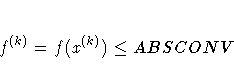
| ABSCONV=r | absolute function convergence criterion |
| MAXFUNC=i | maximum number of function calls |
| MAXITER=i <n> | maximum number of iterations |
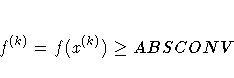
| MAXTIME=r | maximum CPU time |
| MINITER=i | minimum number of iterations |
| Options for Unconstrained and Linearly Constrained Techniques | |
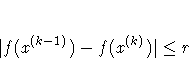
| ABSFCONV=r <n> | absolute change function convergence criterion |
| ABSGCONV=r <n> | absolute gradient convergence criterion |
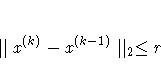
| ABSXCONV=r <n> | absolute change parameter convergence criterion |
| FCONV=r <n> | relative change function convergence criterion |
| FCONV2=r <n> | function convergence criterion |
| FDIGITS=r | precision in computation of the objective function |
| FSIZE=r | parameter for FCONV= and GCONV= |
| GCONV=r <n> | relative gradient convergence criterion |
| GCONV2=r <n> | relative gradient convergence criterion |
| XCONV=r <n> | relative change parameter convergence criterion |
| XSIZE=r | parameter for XCONV= |
| Options for Nonlinearly Constrained Techniques | |
| ABSGCONV=r <n> | maximum absolute gradient of Lagrange function criterion |
| FCONV2=r <n> | predicted objective function reduction criterion |
| GCONV=r <n> | normalized predicted objective function reduction criterion |
| Option |
Short Description |
| Options for the Approximate Covariance Matrix of Parameter Estimates | |
| CFACTOR=r | scalar factor for STDERR |
| NOHLF | use Hessian of the objective function for STDERR |
| Options for Additional Displayed Output | |
| PALL | display initial and final optimization values |
| PCRPJAC | display approximate Hessian matrix |
| PHESSIAN | display Hessian matrix |
| PHISTORY | display optimization history |
| PINIT | display initial values and derivatives (PALL) |
| PNLCJAC | display Jacobian matrix of nonlinear constraints (PALL) |
| display results of the optimization process | |
| Additional Options for Optimization Techniques | |
| DAMPSTEP< =r > | controls initial line-search step size |
| HESCAL=n | scaling version of Hessian or Jacobian |
| LCDEACT=r | Lagrange multiplier threshold of constraint |
| LCEPSILON=r | range for boundary and linear constraints |
| LCSINGULAR=r | QR decomposition linear dependence criterion |
| NOEIGNUM | suppress computation of matrices |
| RESTART=i | restart algorithm with a steepest descent direction |
| VERSION=1 | 2 | quasi-Newton optimization technique version |
 , that is used for the inversion of the Hessian matrix.
The default value is 1E-8.
, that is used for the inversion of the Hessian matrix.
The default value is 1E-8.
| TECH= | MAXFUNC default |
| LEVMAR, NEWRAP, NRRIDG, TRUREG | i=125 |
| DBLDOG, QUANEW | i=500 |
| CONGRA | i=1000 |
| TECH= | MAXITER default |
| LEVMAR, NEWRAP, NRRIDG, TRUREG | i=50 |
| DBLDOG, QUANEW | i=200 |
| CONGRA | i=400 |

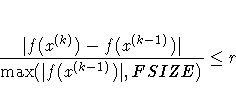
 , where
 is the machine precision.
The optional integer value n determines the number of successive
iterations for which the criterion must be satisfied before the
process can be terminated.
is the machine precision.
The optional integer value n determines the number of successive
iterations for which the criterion must be satisfied before the
process can be terminated.
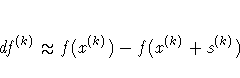
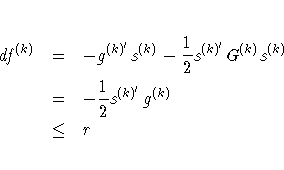
 , where is the machine precision. The value of r is used for the
specification of the default value of the FCONV= option.
, where is the machine precision. The value of r is used for the
specification of the default value of the FCONV= option.
![{ [g^{(k)}]^' [G^{(k)}]^{-1} g^{(k)} \over
\max(| f(x^{(k)})|,FSIZE) } \leq r](images/caleq99.gif)
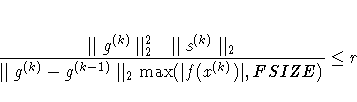
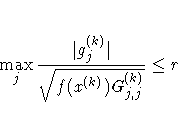
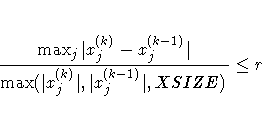
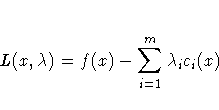

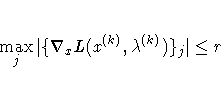
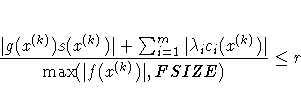
 denotes the m vector
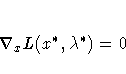
of Lagrange multipliers. The Kuhn-Tucker conditions
require that the gradient of the Lagrange function is zero at
the optimal point
denotes the m vector
of Lagrange multipliers. The Kuhn-Tucker conditions
require that the gradient of the Lagrange function is zero at
the optimal point  :
:

 replaces the default value c/NM.
For more details, see the section "Approximate Standard Errors".
replaces the default value c/NM.
For more details, see the section "Approximate Standard Errors".
 for each line search
(used by the QUANEW, CONGRA, or NEWRAP techniques) cannot be larger
than r times the step-size value used in the former
iteration. If the factor r is not specified, the
default value is r=2. The DAMPSTEP option can prevent the
line-search algorithm from repeatedly stepping into
regions where some objective functions are difficult to compute
or where they can lead to floating point overflows during the
computation of objective functions and their derivatives.
The DAMPSTEP<=r> option can prevent time-costly function calls
during line searches with very small step sizes
for each line search
(used by the QUANEW, CONGRA, or NEWRAP techniques) cannot be larger
than r times the step-size value used in the former
iteration. If the factor r is not specified, the
default value is r=2. The DAMPSTEP option can prevent the
line-search algorithm from repeatedly stepping into
regions where some objective functions are difficult to compute
or where they can lead to floating point overflows during the
computation of objective functions and their derivatives.
The DAMPSTEP<=r> option can prevent time-costly function calls
during line searches with very small step sizes  of
objective functions.
For more information on setting
the start values of each line search, see the section "Restricting the Step Length".
of
objective functions.
For more information on setting
the start values of each line search, see the section "Restricting the Step Length".
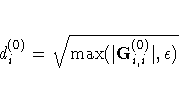
 (1978) scaling update:
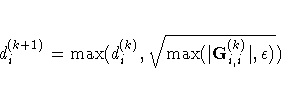
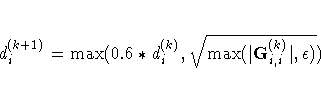
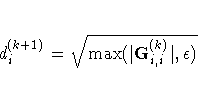 is the relative machine precision.
The default is HS=1 for LEVMAR minimization and HS=0 otherwise.
Scaling of the Hessian or crossproduct Jacobian can be
time-consuming in the case where general linear constraints
are active.
is the relative machine precision.
The default is HS=1 for LEVMAR minimization and HS=0 otherwise.
Scaling of the Hessian or crossproduct Jacobian can be
time-consuming in the case where general linear constraints
are active.
 ,for active and violated boundary and linear
constraints. If the point x(k) satisfies the condition
,for active and violated boundary and linear
constraints. If the point x(k) satisfies the condition
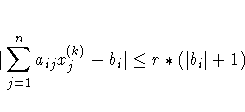 , used in the update of
the QR decomposition that decides whether an active
constraint is linearly dependent on a set of other active
constraints. The default is r=1E-8. The larger r becomes,
the more the active constraints are recognized as being
linearly dependent.
, used in the update of
the QR decomposition that decides whether an active
constraint is linearly dependent on a set of other active
constraints. The default is r=1E-8. The larger r becomes,
the more the active constraints are recognized as being
linearly dependent.
 PB: i = min(10n,80),
where n is the number of parameters.
PB: i = min(10n,80),
where n is the number of parameters.
 vector
as in Powell (1978a, 1978b) (update like VF02AD).
vector
as in Powell (1982a, 1982b) (update like VMCWD).
vector
as in Powell (1978a, 1978b) (update like VF02AD).
vector
as in Powell (1982a, 1982b) (update like VMCWD).
|
Chapter Contents |
Previous |
Next |
 Top |
Copyright © 1999 by SAS Institute Inc., Cary, NC, USA. All rights reserved.