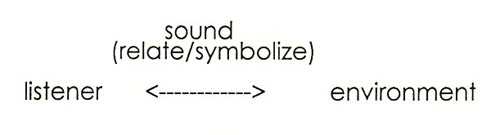
as the embodied interface between the individual and the environment
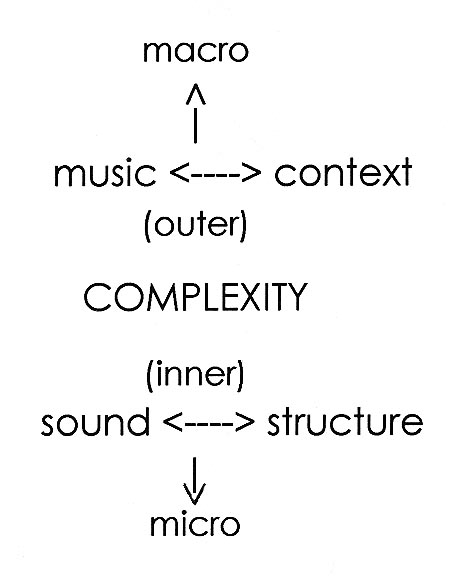
Soundscape competence involves both the perception of sonic patterns (internal complexity)
and their interpretation within the environmental and cultural context (external complexity)
Both are intertwined in the perception of Acoustic Space
and auditory stream formation, because every sound contains within it the "trace" of its spatial context
Movement is key to spatial perception (soundwalking)
Mediation Model
________________________________________
Soundscape Definition (Handbook for Acoustic Ecology, 1978)
ISO Working Group 54 (2012)
Soundscape: acoustic environment as perceived or experienced and/or understood by people, in context
Acoustic environment: sound from all sound sources as modified by the environment. (Acoustic environments can be actual or simulated, outdoor or indoor, as experienced or in memory)
______________________________________________________________________________________________________________
Levels of listening attention are always involved, not just foreground
i.e. background listening is also listening
Electroacoustics extends and transforms listening experience profoundly
as a consumer activity
but it also increases soundscape competence by introducing new forms of complexity
such as dealing with apparent contradictions in embedded environments
Initial disruptions are often quickly re-negotiated to fit within social norms
________________________________________
Soundscape Composition: context-based composition; extending from real-world soundscapes (e.g. Pendlerdrom), through enhanced soundscapes (e.g. Aeolian Voices and Rainforest Raven) to virtual soundscapes (e.g. Chalice Well)
Sonification/Audification <------------> Phonography
Real world data mapped onto / interpreted as sound
science in the service of art - or - art in the service of science?
Sound sculpture / installation activated by the real world; Ecoacoustics
Re-mapping sound from the real world ----> virtual worlds
Representing The Real
(Soundscape Composition)
Phonography <------------> Imaginary worlds
Drever: representation of what? how and for whom? Ethnography vs sonic tourism
Wagstaff (TESE project): participant involvement
Feld: Acoustemology
Westerkamp: acoustic ecology, environmental activism and sustainability
Krause: niche hypothesis
SOUNDSCAPE COMPOSITION PRINCIPLES
- Listener recognizability of the source material is maintained
- Listener's knowledge of the environmental and psychological context is invoked
- Composer's knowledge of the environmental and psychological context influences the shape of the composition at every level
- The work enhances our understanding of the world and its influence carries over into everyday perceptual habits
Acoustic Ecology
Real-world Contexts
Soundscape
Abstracted
Abstract
Sound Object
Musical or Acousmatic Context
Microsound
_____________________________________________