Experimenting Arab Cinema • Enfolding-Unfolding Aesthetics • Islamic Genealogies of New Media Art • Media Art and Experimental Cinema • Haptic Visuality • Smells and Senses • Plant Life
Experimenting Arab Cinema
Hanan al-Cinema: Affections for the Moving Image (2015, MIT Press)
My program for the Robert Flaherty Film Seminar, Colgate, NY, June 13-19 2015, with a program that brings together Arab and other international filmmakers around the theme The Scent of Places—عطر الأماكن
Other publications (for more see CV page)
"Arab media art: experiments in exhibition," in Film Festival Yearbook: Film Festivals and the Middle East, ed. Dina Iordanova and Stefanie Van de Peer (St. Andrews University Press, 2014)
“Arab Glitch,” in Uncommon Grounds: New Media and Visual Practice in the Middle East and North Africa, ed. Anthony Downey (I.B. Tauris/Ibraaz Publishing, 2014).
“Imaginal Materials,” catalogue essay, Spectral Imprints, Abraaj Capital Art Prize, ed. Nat Muller (2012). Available on Selected Writings page.
“Calligraphic Animation: Documenting the Invisible,” in Animation 6:3, special issue on documentary (November 2010): 245 - 262.
“Mounir Fatmi,” Millennium Film Journal, 53 (Fall/Winter 2010)
“Akram Zaatari’s In This House: Diagram with Olive Tree,” catalogue essay, Akram Zaatari, Earth of Endless Secrets (Frankfurt: Portikus Gallery, 2010), 228-231.
“Geopolitics hides something in the image; Arab cinema unfolds something else,” in Cinema at the Periphery, ed. Dina Iordanova, David Martin-Jones and Belén Vidal (Detroit: Wayne State University Press), 232-253. Available on Selected Writings page.
“Mohamed Soueid’s Cinema of Immanence,” Jump Cut 49 (2007), www.ejumpcut.org
“Asphalt Nomadism: The new desert in contemporary Arab cinema,” in Landscape Cinema, ed. Martin Lefebvre (Routledge, 2006). Available on Selected Writings page.
“What Is That ‘And’ between Arab Women and Video? The Case of Beirut,” Camera Obscura 18:2 (December): 41-70. Available on Selected Writings page.
“Signs of the time: Deleuze, Peirce and the documentary image,” in The Brain Is the Screen: Gilles Deleuze's Cinematic Philosophy, ed. Gregory Flaxman (Minneapolis: Minnesota University Press, 2000), 193-214. Available on Selected Writings page.
Islamic genealogies of Western art and thought (for more see CV page)
I seek and invent roots in Islamic art and philosophy for contemporary media art and thought. Since the publication of Enfoldment and Infinity, looking at Ibn Sînâ, Mulla Sadrâ Shirazî, and Isma'ili philosophers for sources and parallels to the thought of Spinoza, Leibniz, Whitehead, and Deleuze. Also spending more time with traveling ceramics.
“A World of Flowing, Intensifying Images: Mulla Sadra Meets Cinema Studies,” Film-Philosophy, “A World of Cinemas” special issue, ed. David Martin-Jones, 2016. Available on Selected Writings page.
"Life in the Manifold: Mulla Sadra, Deleuze, Whitehead," [translated into Portuguese], Conexões, University of Campinas, Sao Paulo
"The taming of the haptic space, from Málaga to Valencia to Florence," Muqarnas, special issue on visuality in Islamic art, ed. Olga Bush and Avinoam Shalem, Available on Selected Writings page.
"From haptic to optical, performance to figuration: A history of representation at the bottom of a bowl," in Islam and the Politics of Culture in Europe: Memory, Aesthetics, Art, ed. Frank Peter, Sarah Dornhof, and Elena Arigita (Bielefeld: Transcript-Verlag, 2013), 247-263.
“Imaginal Materials,” catalogue essay, Spectral Imprints, ed. Nat Muller, Abraaj Capital Art Prize, 2012
“A Deleuzian Ijtihad: Unfolding Deleuze’s Islamic sources occulted in the ethnic cleansing of Spain,” in Deleuze and Race, ed. Arun Saldhana Edinburgh University Press, 2012). Available on Selected Writings page.
Enfoldment and Infinity: An Islamic Genealogy of New Media Art. Cambridge, MA: MIT Press, 2010.
"Words dream of being flowers, ducks dream of being words: the becoming-world of foliated Kufic,” in Variantology 4, ed. Siegfried Zielinski and Eckhard Fürlus (Köln: Walther König), 267-288.
"Aniconism: An Islamic Idea Blooms Anew in Contemporary Art, in Now Is the Time: Art and Theory in the 21st Century, ed. Jelle Bouwhis et al. (Amsterdam: NAi Pusblishers), 151-162.
“‘Taking a Line for a Walk’ from Islamic Art to Algorithmic Modernism,” Third Text 23:3 (May 2009): 229-240.
“Genetic algorithms, Kunstwollen, and Caucasian carpets,” in Place Studies in Art, Media, Science and Technology: Historical Investigations on the Sites and the Migration of Knowledge, ed. Andreas Broeckmann and Gunalan Nadarajan (VDG Weimar, 2008). Available on Selected Writings page.
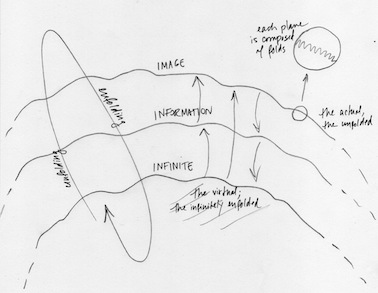
Enfolding-unfolding aesthetics
I propose a triadic, enfolding-unfolding model for understanding the nature of the image in the information age: Image—Information—Infinite. Enfolding-unfolding aesthetics grounds my theoretical approach in Enfoldment and Infinity: An Islamic Genealogy of New Media Art (2010). It synthesizes a monist aesthetics from the triadic logic of C.S. Peirce, Henri Bergson, Leibniz’s philosophy and Deleuze’s revision of it, medieval Isma‘ili thought on latency and manifestation, Ibn Sînâ and Deleuze on the univocity of being, and the process philosophies of A.N. Whitehead and Mulla Sadra.
(for more see CV page)
"Radical gestures of unfolding in films by Mohamed Soueid and The Otolith Group,” Visual Culture and the Aesthetics of Gesture, ed. Asbjørn Gronsted (Routledge, 2016)
“Monad, Database, Remix: Manners of Unfolding in John Akomfrah’s The Last Angel of History,” in special issue of Black Camera on Black Audio Film Collective, ed. Matthias De Groof (2015)
Enfoldment and Infinity: An Islamic Genealogy of New Media Art (2010)
“Enfolding-Unfolding aesthetics, or the unthought at the heart of wood,” in Technology and Desire: The Transgressive Art of Moving Images, ed. Rania Gaafar and Martin Schulz (Karlsruhe: ZKM and London: Intellect Books, 2013) Available on Selected Writings page.
“Thinking like a carpet: embodied perception and individuation in algorithmic media,” in Entautomatisierung [Deautomatization], ed. Annette Brauerhoch et al. (Paderborn, Germany: Wilhelm Fink, 2012) Available on Selected Writings page.
“Noise in Enfolding-Unfolding Aesthetics,” The Oxford Handbook of Sound and Image in Digital Media, ed. Amy Herzog, John Richardson and Carol Vernallis (Oxford UP, 2013)
Enfoldment and Infinity: An Islamic Genealogy of New Media Art. Cambridge, MA: MIT Press, 2010.
“Information, Secrets, and Enigmas: An Enfolding-Unfolding Aesthetics for Cinema,” Screen 50th anniversary issue 50:1 (Spring 2009), 86-98
“Experience – Information – Image: a historiography of unfolding. Arab cinema as example,” Cultural Studies Review (March 2007): 85-98, special issue on “History Experiments.” Another version is “Geopolitics hides something in the image; Arab cinema unfolds something else,” in Cinema at the Periphery, ed. Bélen Vidal (University of Edinburgh Press). Available on Selected Writings page.
On experience in the information age see “Immigrant semiosis,” in Fluid Screens, Expanded Cinema: Digital Futures, ed. Susan Lord and Janine Marchessault (University of Toronto Press, 2007), 284-303. Available on Selected Writings page.I developed enfolding-unfolding aesthetics with designer Raegan Kelly as an animated diagram for Vectors: Journal of Culture and Technology in a Dynamic Vernacular 1:3 (2006)
The model originated in “Invisible Media,” in New Media: Theories and Practices of Digitextuality, ed. Anna Everett and John T. Caldwell (Routledge, 2003)
Media art and experimental cinema (for more see CV page)
Hanan al-Cinema: Affections for the Moving Image. MIT Press, 2015.
“Monad, Database, Remix: Manners of Unfolding in John Akomfrah’s The Last Angel of History,” in special issue of Black Camera on Black Audio Film Collective, ed. Matthias De Groof
Other publications“Immersed in the single channel: Experimental media from theater to gallery,” argues that economics, more than aesthetics, rule the shift of experimental media from single-channel screenings to art galleries. It is published in Millennium Film Journal 55 (Spring 2012): 14-23.
Haptic visuality
My best-known work, inspired by Deleuze and Guattari’s take on Aloïs Riegl’s visual theories.
“I Feel Like an Abstract Line,” in Thresholds: Mirror-Touch Synaesthesia and the Social Life of Art, ed. Daria Martin with Elinor Cleghorn (Oxford, 2018).
“The taming of the haptic space, from Málaga to Valencia to Florence,” Muqarnas, special issue, “Gazing Otherwise,” ed. Olga Bush and Avinoam Shalem (2015).
Other publications
“Haptic Aesthetics,” Oxford Encyclopedia of Aesthetics, ed. Michael Kelly (Oxford University Press, 2014)
On the Islamic origins of abstract line and haptic space and their taming in European art:
Enfoldment and Infinity: An Islamic Genealogy of New Media Art (2010) follows Riegl back to his sources as a textile curator and identifies haptic space and abstract line at work in Islamic art. I argue that Islamic aesthetics introduced these forms to European art.
“From haptic to optical, performance to figuration: A history of representation at the bottom of a bowl," in Islam and the Politics of Culture in Europe, ed. Frank Peter, Sarah Dornhof, and Elena Arigita (Transcript-Verlag Press, 2013) Available on Selected Writings page
“The taming of the haptic space, from Málaga to Valencia to Florence,” Muqarnas, special issue, “Gazing Otherwise,” ed. Olga Bush and Avinoam Shalem (forthcoming)
Its first iteration was a 1993 presentation of “The haptic critic” at “La jeune critique aujourd'hui,” École Nationale Supérieure des Beaux-Arts, Paris.
The first major article was “Video haptics and erotics,” Screen 39:4 (Winter 1998): 331-348.
A characterization of haptic media, and the theory that haptic visuality gives rise to embodied sense memory, are further developed in The Skin of the Film: Intercultural Cinema, Embodiment, and the Senses (2000).
A revised version appears in in Touch: Sensuous Theory and Multisensory Media (2002)
I offer a revision of haptic aesthetics in “Images in Motion, from Haptic Vision to Networked Space,” chapter 8 of Hanan al-Cinema (MIT Press, forthcoming 2015)
Smells and senses
This topic, central to The Skin of the Film and Touch, is never far from my nose.
“Thinking Multisensory Culture” is available in Paragraph 31:2 (July 2008): 123-137, a special issue on cinema and the senses edited by Emma Wilson, and is republished in Art and the Senses (Oxford University Press, 2011) and Carnal Aesthetics, ed. Bettina Papenburg and Marta Zarzycka (Routledge, 2013).
I occasionally give olfactory lectures, such as "Aromatic Events: how plant communication makes us more than human," at the conference "The Secret Life of Plants," Princeton. May 3, 2013 and in Vancouver for the Institute for Social Research, Or Gallery, November 25, 2013.
Plant life
“Vegetable Locomotion: A Deleuzian ethics/aesthetics of traveling plants,” in Revisiting Normativity with Deleuze, ed. Rosi Braidotti and Patricia Pisters (London: Continuum, 2012)
"Aromatic Events: how plant communication makes us more than human," at the conference "The Secret Life of Plants," Princeton. May 3, 2013