


Stopping time for
the Markov chain is a random variable T taking values in
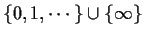 such that for each finite k
there is a function fk such that
such that for each finite k
there is a function fk such that

Standard shorthand notation: by
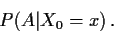

Goal: explain and prove

Simpler claim:

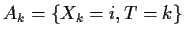
Notice:
 :
:
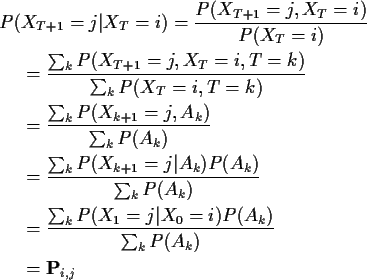
Notice use of fact that
T=k is event defined in terms of
 .
.
Technical problems with proof:
 It might be that
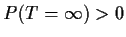 .
What are
XT and XT+1 on the event
.
What are
XT and XT+1 on the event  .
.
Answer: condition also on  .
.
Prove formula only for stopping times
where
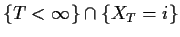 has
positive probability.
has
positive probability.
We will now fix up these technical details.
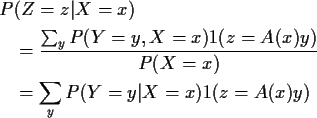
When X and Y are discrete we have

Defines a function of x.
This function evaluated at X gives
rv which is ftn of X denoted

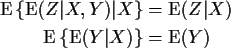
Here are some properties of that function.


Second assertion follows from first.
Note that if Z=A(X) Y then
Z is discrete and



Definition of
 when
X and Y are not assumed to discrete:
when
X and Y are not assumed to discrete:
is rv which is measurable function
of X satisfying(1).
Existence is measure theory problem.
Suppose
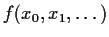 is a (measurable)
function on
is a (measurable)
function on
 .
Put
.
Put

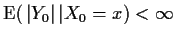 for all x.
Claim:
for all x.
Claim:
 .
.
Proof:
Aside on ``measurable'': what sorts of events can be defined in
terms of a family
 ?
?
Natural: any event of form
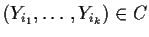 is ``defined in terms of the family'' for any finite set
 and any (Borel) set C in Sk.
For countable S: each singleton
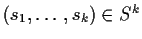 Borel. So every subset of Sk Borel.
Natural: if you can define each of a sequence
of events An in terms of the Ys then the definition ``there
exists an n such that (definition of An) ...'' defines
 .
.
Natural: if A is definable in terms of the Ys then Ac can be defined from the Ys by just inserting the phrase ``It is not true that'' in front of the definition of A.
So family of events definable in terms of the family
is a  -field which includes every
event of the form
.
We call the smallest such -field,
-field which includes every
event of the form
.
We call the smallest such -field,
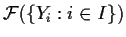 ,
the -field generated by the family
.
,
the -field generated by the family
.
This discussion permits some shorthand. We define


Conditioning on
 where
T is a stopping time?
where
T is a stopping time?
Method 1: regard vector
as taking values in exotic space, namely:
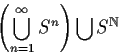
 is discrete on
but
not discrete on .
is discrete on
but
not discrete on .
Suppose X is discrete and X*=g(X) is a one to one transformation
of X. Since X=x is the same event as X*=g(x) we find

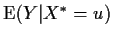 and
and
 .
Then
.
Then

Interpretation.
Formula is ``obvious''.
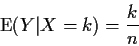
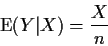
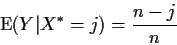
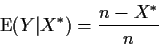
Example: Toss coin n=20 times. Y is
indicator of first toss is a heads. X is number of
heads and X* number of tails. Formula says:

Another interpretation: Rv X partitions
 into countable set of events of the form X=x.
Other rv X* partitions
into the same
events.
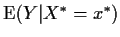
Then values of
 are same as values of
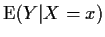 but labelled
differently.
but labelled
differently.
To form
take value  ,
compute
,
compute  to
determine member A of the partition we being conditionsed on,
then write down corresponding
to
determine member A of the partition we being conditionsed on,
then write down corresponding
 .
.
Hence conditional expectation depends only on partition of .
X not discrete: replace partition with -field.
Suppose X and X*
2 rvs such that
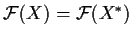 .
Then:
.
Then:
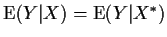 almost surely.
In other words
depends only on the -field
generated by X. We write

Definition: Suppose  is sub--field of
  .
X is
measurable if, for every Borel B
.
X is
measurable if, for every Borel B

Definition:
 is any
measurable rv s.t.
for every
measurable rv variable Awe have
is any
measurable rv s.t.
for every
measurable rv variable Awe have

Now we define
 to be the collection of all events
B such that
to be the collection of all events
B such that
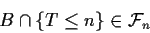 is a
-field and that T and XT are
measurable.
is a
-field and that T and XT are
measurable.
Rewrite Strong Markov Property: if
 is Borel and
 and
and
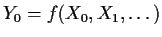 and
and
 for all x.

Proof of Strong Markov Property.
Since T is
measurable we have

Suppose A is
measurable; need only prove

Break up the events according to
value of T:
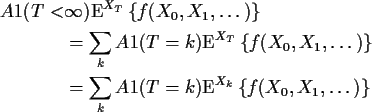
On the other hand
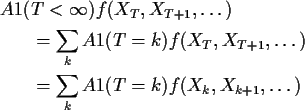
But by our extended Markov property
![\begin{align*}{\rm E}& \left\{ A1(T=k)f(X_k,X_{k+1},\ldots)\right\}
\\
& =
{\r...
...\left[A1(T=k){\rm E}^{X_k}\left\{f(X_0,X_{1},\ldots)\right\}\right]
\end{align*}](img80.gif)
Exactly expectation of kth term in (![[*]](/fas-info/icons//cross_ref_motif.gif) ).
This proves the Strong Markov Property.
).
This proves the Strong Markov Property.

