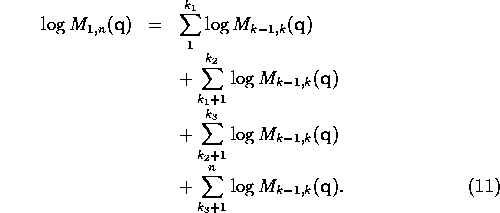
We have now reduced the proof of theorem 3 to that of establishing

almost surely. We will prove this by establishing
almost surely and
almost surely.
To prove 9 note that  differs from

by a constant not depending on  (note that we suppress the
dependence
of
(note that we suppress the
dependence
of  and
and  on ). For fixed this is maximized
as a
function of by
on ). For fixed this is maximized
as a
function of by  . The profile obtained by replacing
by
is concave and is maximized over all by
. The profile obtained by replacing
by
is concave and is maximized over all by  .
Since
this estimate is strongly consistent on the explosion set, the profile
is
maximized, subject to
.
Since
this estimate is strongly consistent on the explosion set, the profile
is
maximized, subject to  at one of
the two
points
at one of
the two
points  . Finally, 9 is
easily established by considering the two values individually.
. Finally, 9 is
easily established by considering the two values individually.
Fix  and let
  be the event that
  for
all
for
all  . Then
  and
and  is the explosion
set except for a
is the explosion
set except for a  -null event. For trajectories in
  with
with
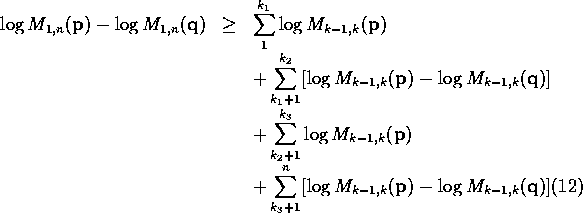
 chosen large we write
We will choose  and
and  depending on . In particular
let
depending on . In particular
let

with  to be chosen later and

Each  is a probability so bounded by 1. Thus
The first term in 12 is free of and after
division by  converges to 0 almost
surely on . Also on
converges to 0 almost
surely on . Also on  grows exponentially
when
grows exponentially
when  and so
 . From 1
we obtain
. From 1
we obtain
On  we have
  . Thus, except for a fixed number of
  (depending only on and
  ) the right hand side of 13 is less than
  permitting a Taylor expansion of the
  . Hence

almost surely.
For the fourth term in 12 we have
for all  . Letting
  a Taylor expansion of the logarithm then shows that
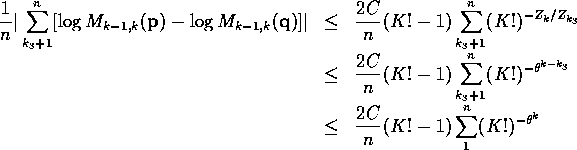
which converges to 0 almost surely.
It remains to deal with the second term in 12.
This
is
the most technical part of the argument.
Consider now any for which  . (Remember that
depends on .) There is an
. (Remember that
depends on .) There is an  for which
 . There is then a constant
  not
depending
on or
not
depending
on or  such that for all small

Since  is in the convex hull of the points
  as
as  runs over
  and since this convex
hull is a regular polygon there is a constant
and since this convex
hull is a regular polygon there is a constant  depending only on
such that there must exist an
depending only on
such that there must exist an  with
with

Finally there is a  depending only on such that
Let  be the set of all such that 15
holds. Note that either
be the set of all such that 15
holds. Note that either  and the second term above is 0 or
belongs to some . For in
and
and the second term above is 0 or
belongs to some . For in
and  we have

Let

Then

An argument like that at (14)
shows that the sequence  is asymptotically
an iid sequence of uniformly distributed random variables. Using this argument we can establish
is asymptotically
an iid sequence of uniformly distributed random variables. Using this argument we can establish

Since  we can choose so that

With this choice of we can use the lemma to prove

Theorem 3 follows.