
Oral Cancer, Socioeconomic Status, and Access to Health Care in BC
Vancouver Area Neighbourhood Deprivation Index (VANDIX)

The VANDIX measures population health outcomes across British Columbia
Socioeconomic status was assessed in this project using the Vancouver Area Neighbourhood Deprivation Index (VANDIX). The index was developed to analyze small area distribution of health status within urban areas in BC.
The VANDIX was constructed from a 2005 survey of eighteen provincial medical health officers regarding socioeconomic factors such as housing and education that contribute to health status in the province. The officers were given a list of 21 indicators separated into seven categories. The 21 indicators were chosen because they reflect the conditions of social and material deprivation. They are also relevant when studying urban areas in BC and have been used to construct area-based deprivation indicators in the past.
The seven indicators which the officers believed to contribute most to health outcomes within urban areas were selected to measure the deprivation score. Within the deprivation score calculation, each indicator selected was assigned a weight relative to their importance (Bell & al., 2007). Deprivation scores were calculated for each dissemination area using data from the 2006 Canadian Census. The results of the VANDIX reinforced the association of social and economic inequalities to health inequalities and helped to highlight deprived areas.


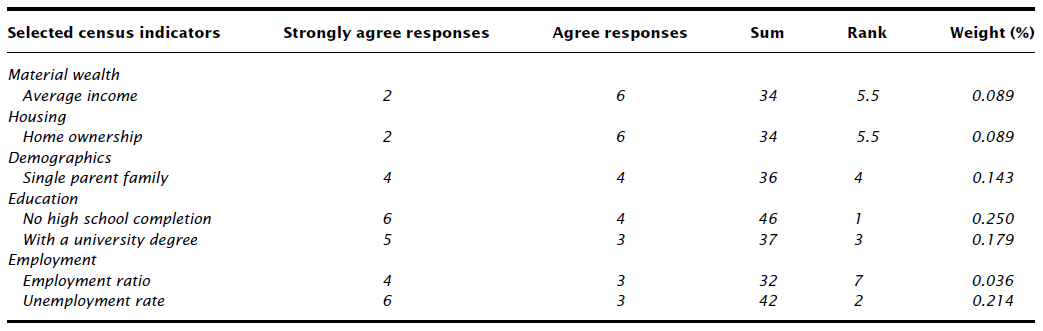
The seven indicators selected to measure neighbourhood deprivation and their assigned weights.
Table Source: Bell & al., 2007


