
Chapter Contents

Previous

Next
|
Chapter Contents |
Previous |
Next |
| Language Reference |
See "Nonlinear Optimization and Related Subroutines" for a listing of all NLP subroutines. See Chapter 11, "Nonlinear Optimization Examples," for a description of the inputs to and outputs of all NLP subroutines.
The NLPNRR algorithm uses a pure Newton step when both the Hessian is positive definite and the Newton step successfully reduces the value of the objective function. Otherwise, a multiple of the identity matrix is added to the Hessian matrix.
The subroutine uses the gradient 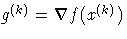 and the Hessian matrix
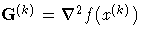 ,and it requires continuous first- and second-order derivatives
of the objective function inside the feasible region.
,and it requires continuous first- and second-order derivatives
of the objective function inside the feasible region.
Note that using only function calls to compute finite difference approximations for second-order derivatives can be computationally very expensive and may contain significant rounding errors. If you use the "grd" input argument to specify a module that computes first-order derivatives analytically, you can reduce drastically the computation time for numerical second-order derivatives. The computation of the finite difference approximation for the Hessian matrix generally uses only n calls of the module that specifies the gradient.
The NLPNRR method performs well for small to medium-sized problems, and it does not need many function, gradient, and Hessian calls. However, if the gradient is not specified analytically by using the "grd" module argument, or if the computation of the Hessian module specified with the "hes" argument is computationally expensive, one of the (dual) quasi-Newton or conjugate gradient algorithms may be more efficient.
In addition to the standard iteration history, the NLPNRR subroutine prints the following information:
 , the ratio of the
achieved difference in function values and the predicted
difference, based on the quadratic function approximation.
A value that is much smaller than one
indicates possible optimization difficulties.
, the ratio of the
achieved difference in function values and the predicted
difference, based on the quadratic function approximation.
A value that is much smaller than one
indicates possible optimization difficulties.
The following statements invoke the NLPNRR subroutine to solve the constrained Betts optimization problem (see "Constrained Betts Function" ). The iteration history is shown in Figure 17.8.
   proc iml;
      start F_BETTS(x);
         f = .01 * x[1] * x[1] + x[2] * x[2] - 100.;
         return(f);
      finish F_BETTS;

      con = {  2. -50.  .   .,
              50.  50.  .   .,
              10.  -1. 1. 10.};
      x = {-1. -1.};
      optn = {0 2};
      call nlpnrr(rc,xres,"F_BETTS",x,optn,con);
      quit;
                      Optimization Start
                      Parameter Estimates

                           Gradient    Lower        Upper
                           Objective   Bound        Bound
 N Parameter   Estimate    Function    Constraint   Constraint

 1 X1          6.800000    0.136000    2.000000     50.000000
 2 X2         -1.000000   -2.000000   -50.000000    50.000000

           Value of Objective Function = -98.5376


                       Linear Constraints

1   59.00000 :      10.0000  <=   +   10.0000 * X1        -    1.0000 * X2


            Newton-Raphson Ridge Optimization

               Without Parameter Scaling
       Gradient Computed by Finite Differences
     CRP Jacobian Computed by Finite Differences

         Parameter Estimates               2
         Lower Bounds                      2
         Upper Bounds                      2
         Linear Constraints                1


                 Optimization Start

Active Constraints         0  Objective Function   -98.5376
Max Abs Gradient Element   2


                    Function        Active       Objective
 Iter    Restarts      Calls   Constraints        Function

    1           0          2             1       -99.87337
    2           0          3             1       -99.96000
    3           0          4             1       -99.96000


                                            Ratio
                                           Actual
        Objective    Max Abs                  and
         Function   Gradient            Predicted
 Iter      Change    Element    Ridge      Change

    1      1.3358     0.5887        0       0.706
    2      0.0866   0.000040        0       1.000
    3    4.07E-10          0        0       1.014


                  Optimization Results

   Iterations               3  Function Calls                       5
   Hessian Calls            4  Active Constraints                   1
   Objective Function  -99.96  Max Abs Gradient Element             0
   Ridge                    0  Actual Over Pred Change   1.0135158294


   GCONV convergence criterion satisfied.

                Optimization Results
                Parameter Estimates


                                     Gradient    Active
                                     Objective    Bound
 N Parameter         Estimate        Function    Constraint

 1 X1                2.000000        0.040000     Lower BC
 2 X2             0.000000134               0

         Value of Objective Function = -99.96


         Linear Constraints Evaluated at Solution

1       10.00000  =  -10.0000 + 10.0000 * X1 - 1.0000 * X2
Figure 17.8: Iteration History for the NLPNRR Subroutine
|
Chapter Contents |
Previous |
Next |
 Top |
Copyright © 1999 by SAS Institute Inc., Cary, NC, USA. All rights reserved.