Abstracts
Effects of acoustic and linguistic aspects on Japanese pitch accent processing
Xianghua Wu, Saya Kawase, and Yue Wang
This study investigates the hemispheric processing of Japanese pitch accent by native and non-native listeners. The non-natives differ in their first (L1) and second (L2) language experience with prosodic pitch, including Mandarin (tonal L1) and English (non-tonal L1) listeners with or without Japanese learning experience. All listeners completed a dichotic listening test in which minimal pairs differing in pitch accent were presented. Overall, the results demonstrate a right hemisphere lateralization across groups, indicating holistic processing of temporal cues as the pitch accent patterns span across disyllabic domain. Moreover, the three pitch accent patterns reveal different degrees of hemispheric dominance, presumably attributable to the acoustic cues to each pattern which involve different hemispheric asymmetries. The results also reveal group difference, reflecting the effects of linguistic experience. Specifically, the English listeners with no Japanese background, compared to the other groups, exhibit greater variance in hemispheric dominance as a function of pitch accent difference, showing a greater reliance on acoustic cues when linguistic information is lacking. Together, the findings suggest an interplay of acoustic and linguistic aspects in the processing of Japanese pitch accent but showing a more prominent acoustic influence. [Research supported by NSERC]
The influence of visual information on the perception of Japanese-accented speech
Saya Kawase, Beverly Hannah, and Yue Wang
This study examines how visual information in nonnative speech affects native listener judgments of second language (L2) speech production. Native Canadian English listeners perceived three English phonemic contrasts (/b-v, θ-s, l-ɹ/) produced by native Japanese speakers as well as native Canadian English speakers as controls. Among the stimuli, / v, θ, l, ɹ/ are not existent in the Japanese consonant inventory. These stimuli were presented under audio-visual (AV), audio-only (AO), and visual-only (VO) conditions. The results showed that while overall perceptual judgments of the nonnative phonemes (/v, θ, l, ɹ/) were significantly less accurate / less intelligible than the native phonemes (/b,s/), the English listeners perceived the Japanese productions of the phonemes /v, θ, b,s/ as significantly more intelligible when presented in AV compared to the AO condition. However, the Japanese production of /ɹ/ was perceived as less intelligible in the AV compared to the AO condition. Further analysis revealed that a significant number of Japanese productions of /ɹ/ lacked lip-rounding, indicating that nonnative speakers’ incorrect articulatory configurations may decrease intelligibility. These results suggest that visual cues in L2 speech productions may be either facilitative or inhibitory in native perception of L2 accented-speech. [Research supported by SFU and SSHRC]
Cross-language assimilation of lexical tone
Alexander, J.A. and Wang, Y.
We extend to lexical-tone systems a model of second-language perception, the Perceptual Assimilation Model (PAM) [Best & Tyler, 2007], to examine whether/how native-language lexical-tone inventory composition influences perception of novel tone. Native listeners of Cantonese, Thai, and Mandarin perform a tone mapping-rating assimilation task. Listeners hear CV syllables bearing all tones of Cantonese, Thai, Mandarin, and Yoruba – languages with different tone inventories. They (1) map the tone they hear to the nearest native tone category, and (2) provide a goodness rating on a 5-point scale (5 = perfect). As predicted by the PAM, listeners assimilated non-native tones to the phonetically-closest native tone categories. Listeners attended primarily to pitch-contour, and secondarily to pitch-height, contrasts for the mappings. E.g., Mandarin listeners assimilated the Thai high “level” (phonetically mid-to-high-rising) tone to Mandarin rising tone 76% of the time, and to Mandarin high-level tone only 22% of the time. Also as predicted, all novel tones did not assimilate equally well to native categories; mappings received ratings between 2.9-4.1, averaging 3.5. The groups’ different patterns of results indicate that novel-tone perception is influenced by experience with the native-language tone inventory, and that listeners attend to gradient phonetic detail to assimilate novel tones to native-tone categories. This work is supported by NSF grant 0965227 to J.A.





 The LABLab would like to thank Parveen Kaila & Roxane Chan for their hard work and dedication to the LABlab. We will miss their presence at the lab, but wish all the best for what comes for them in the future!





 We would like to welcome Elysia Saundry (Left) and Lisa Tang (Right) to the LABlab team! Elysia is a BA Student majoring in linguistics with an extended minor in psychology. She is interested in speech perception and bilingualism, and she enjoys hiking the trails around the Greater Vancouver area. Lisa is a Graduate Student in the Computing Sciences program. Her research interests involve tracking, image registration, motion analysis, and shape matching. Lisa will be assisting on a new project which compares clear and conversational speech.

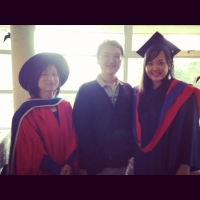
 The LABlab would like to congratulate this year's graduates of the Linguistics department as well as graduates of all other departments at SFU!

 May 15, 2013