Earthquake Early Warning Systems Modeling for North Vancouver
A Geography 355 Final Project by Tom McKay
Introduction
Since 2001 the B.C. government has spent or committed $2.2 billion to seismically upgrade or replace 214 high-rish schools, and it is anticipated that it will cost a further $600 million to address the remaining 104 high-risk schools in the provice. As of November 2013 there are 133 schools that have completed their seismic updates, 14 under construction, 7 proceeding to construction, and 60 supported to proceed.
For the North Vancouver School District, 7 of 32 Schools have either been seismically updated, or are slated to be seismically updated, pictured in the map below:
What becomes apparent is that despite the massive amounts of investment into seismic updates, a very small portion of schools in North Vancouver have actually benefited from the program. This is due to a variety of reasons, first and formost being the cost of seismic updates. In their comprehensive assessment of VSB school buildings with significan seismic risk, the Vancouver School Board found that preliminary estimates of the cost of seismic upgrading in some schools were higher than the cost of building a new school. Seismic upgrades are also very time consuming, and Schools or sections of schools need to be closed down during the construction process.
While much of the focus of these programs is for preparation for a ~M 9.0 megathrust earthquake with a 500 to 600 year recurrence interval, the Cascadia subduction zone off the coast of B.C also produces less severe but still damaging earthquakes on shorter intervals. Even if we were to focus solely on the megathrust earthquake event, time reamins of the essence for earthquake mitigation programs as geologists in 2010 predicted a 37% chance of an M 8.2 + event occuring in the Cascadia subduction zone within 50 years.
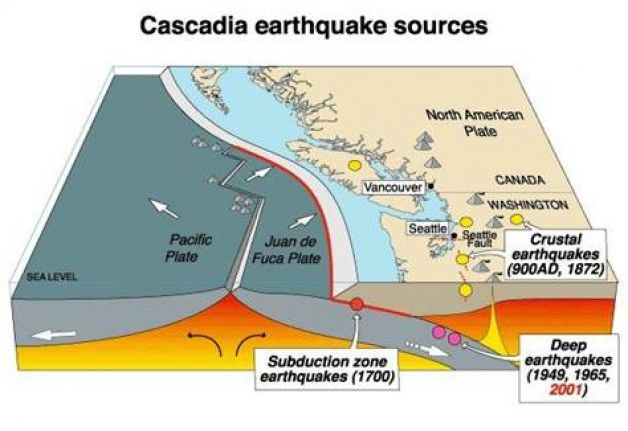
While the seismic update of schools is integral to a successful earthquake mitigation program for British Columbia, there are other tools available that could greatly assisst in helping schools that have yet to benefit from the seismic update program as well as increase the effectiveness of already updated schools. The mitigation tools I will be focusing on for this analysis are P-Wave sensors for use in Earthquake Early Warning Systems (EEWS).
Why are EEWS important to North Vancouver?
P-wave sensors for use in Vancouver's Earthquake Early Warning Systems are a cost effective, easy to implement, and extremely valuable tool for earthquake damage mitigation and emergency response. An EEWS can be used to create audio alarms that alert people and provide time for them to get to cover and secure themselves properly, and if there is enough time between the triggering of the alarm and the arrival of damaging S waves there is potential to turn off potentially dangerous electronic devices. They are integrated with a network of other devices, and information is relayed to the British Columbia Smart Infrastructure Monitoring System (BCSIMS) which uses the data to model the health of the buildings with sensors. Information can also be used to determine which areas were hit the hardest by the earthquake for use in developing an effective post-quake emergency response.
The sensors cost $30,000 to $50,000 to insall in a school building, and have a 95 to 98 per cent reliability rate. The Archdiocese of Vancouver is the first organization in Vancouver to commit to wide scale use of the technology, and a spokesperson for the Archdiocese stated that "You don't have to wait years for fundraising or upgrades of buildings - there are things that can be done right now."
In this project I will be attempting to strategically find the best locations for P-Wave sensors in NVSD schools. The goal of this project is to model an Earthquake Early Warning System for the NVSD that would be both cost-effective and integrate as much information as possible for all schools in the district, with a focus on the most at-risk schools.
The next section will be a more in-depth look at how Earthquake Early Warning Systems function.