

- Undergraduates
- Graduate
- Research
- Algebraic and Arithmetic Geometry
- Applied Mathematics
- Centre for Operations Research and Decision Sciences
- Computer Algebra
- Discrete Mathematics
- Mathematics, Genomics & Prediction in Infection & Evolution - MAGPIE
- Mathematics and Data
- Mathematics of Communications
- Number Theory
- Operations Research
- PIMS at SFU
- Scientific Computing, Machine Learning and PDE
- People
- Department
- Events
- Tutor Request
- Math Internal Resources
- Grad Internal Resources
- Postdoc Vacations
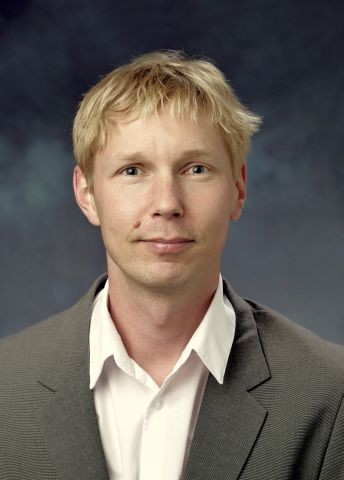
Daniel Appelö
Areas of interest
Daniel Appelö is a numerical analyst and computational mathematician. His group develops fast, stable, and accurate numerical algorithms for the differential equations that arise in engineering and the natural sciences, following each idea from its mathematical formulation through rigorous analysis to open-source software that others can use. Much of this work concerns wave propagation: high-order methods for acoustic, elastic, and electromagnetic waves, including Hermite methods and energy-based discontinuous Galerkin and finite difference methods whose stability follows from a discrete energy estimate; perfectly matched layers and non-reflecting boundary conditions for simulations on unbounded domains; and the WaveHoltz family of frequency-domain solvers, which solve the Helmholtz and time-harmonic Maxwell equations by iterating an ordinary time-domain wave solver and therefore scale to large problems on parallel and GPU hardware.
A growing part of his research brings the tools of numerical analysis to quantum computing. This includes structure-preserving, low-rank, and tensor-network solvers for the Schrödinger and Lindblad equations that keep the simulated quantum state physically valid at every step, high-order methods for quantum optimal control, and Bayesian characterization of quantum devices from noisy measurements. The long-term goal of this program is the development of quantum digital twins: self-correcting computational replicas of quantum hardware that learn from measurements and in turn guide the design and control of the device. Related interests include low-rank and tensor methods for matrix differential equations, low-rank Anderson acceleration, and the acceleration of numerical methods through efficient algorithms and modern computing hardware. He welcomes inquiries from prospective graduate students and postdoctoral fellows interested in any of these areas.
Education
- Ph.D. Numerical Analysis · KTH Royal Institute of Technology, Stockholm · 2006
- Licentiate, Numerical Analysis · KTH Royal Institute of Technology, Stockholm · 2003
- M.S. Electrical Engineering · KTH Royal Institute of Technology, Stockholm · 2001
Courses
This instructor is currently not teaching any courses.