Welcome to SFU.ca.
You have reached this page because we have detected you have a browser that is not supported by our web site and its stylesheets. We are happy to bring you here a text version of the SFU site. It offers you all the site's links and info, but without the graphics.
You may be able to update your browser and take advantage of the full graphical website. This could be done FREE at one of the following links, depending on your computer and operating system.
Or you may simply continue with the text version.

*Windows:*
FireFox (Recommended) http://www.mozilla.com/en-US/firefox/
Netscape http://browser.netscape.com
Opera http://www.opera.com/

*Macintosh OSX:*
FireFox (Recommended) http://www.mozilla.com/en-US/firefox/
Netscape http://browser.netscape.com
Opera http://www.opera.com/

*Macintosh OS 8.5-9.22:*
The only currently supported browser that we know of is iCAB. This is a free browser to download and try, but there is a cost to purchase it.
http://www.icab.de/index.html
donation

About Terry Fox

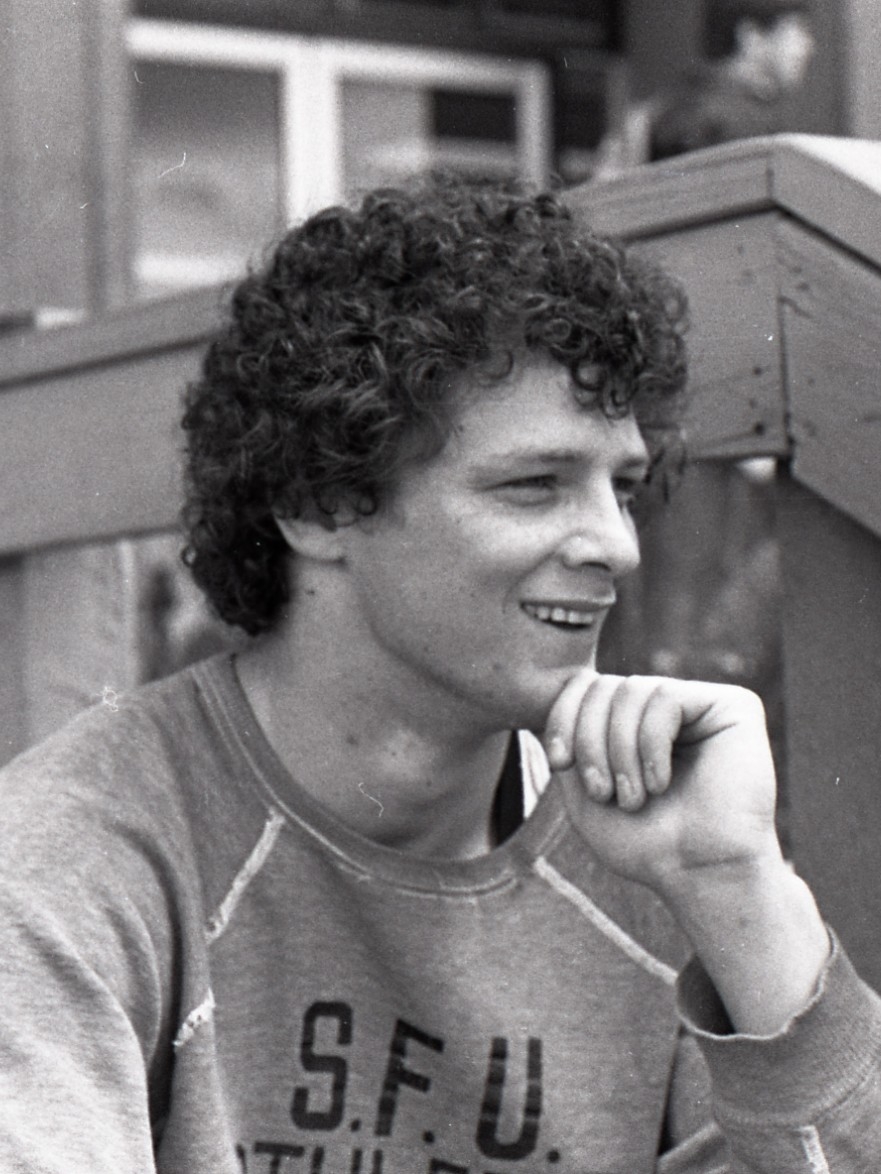
Terry was an 18 year old first year Kinesiology student at SFU and a member of the SFU junior varsity basketball team in 1977 when he was diagnosed with bone cancer that resulted in the amputation of his right leg six inches above the knee. After undergoing chemotherapy and seeing other people, particularly children, suffering with cancer, Terry decided that he wanted to make a difference in the world, he wanted to do something to help cure this dreadful disease.

Terry began his Marathon of Hope on April 12, 1980 in St. John's Newfoundland. When he was forced by a recurrence of cancer to stop his cross-Canada run at Thunder Bay, Ontario, on September 1, 1980, he had completed a total of 5,373 km over 143 days, the equivalent of a marathon every day. After a courageous battle with cancer he passed away in June 1981.

Few people are aware of the physical enormity of what Terry did in his Marathon of Hope run across Canada. He ran 26 miles per day, 7 days per week. Imagine how sore your legs would be if you walked 26 miles day after day on pavement. Imagine how much sorer your legs would be if you ran 26 miles day after day. Few people could stand up to such punishment. Then try to imagine how incredibly difficult and painful it would be to run 26 miles per day with an artificial limb. It is almost beyond comprehension.

It was a journey that Canadians will never forget. His courage, determination, humanitarianism, and selflessness have been an inspiration to millions of people.

In the 28 years since Terry's death, the Terry Fox Foundation has raised over 400 million dollars worldwide for cancer research. This money has been used to produce better treatments for many different types of cancers. These newer treatments reduce suffering and prolong life and bring us closer to an eventual cure for cancer.

In November 2004, Canadians voted Terry Fox the second Greatest Canadian of all time, after Tommy Douglas, following a nationwide contest organized by CBC (over 1.2 million votes were cast). A 1999 national internet survey named him Canada's greatest hero. And this famous Canadian hero whose legacy has inspired and helped so many people, was a student at Simon Fraser University!


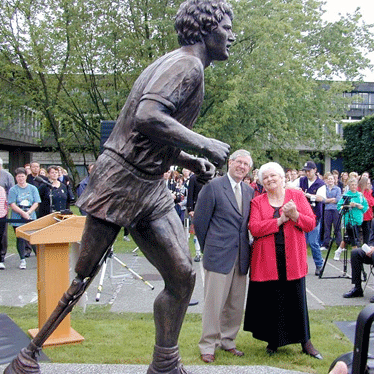
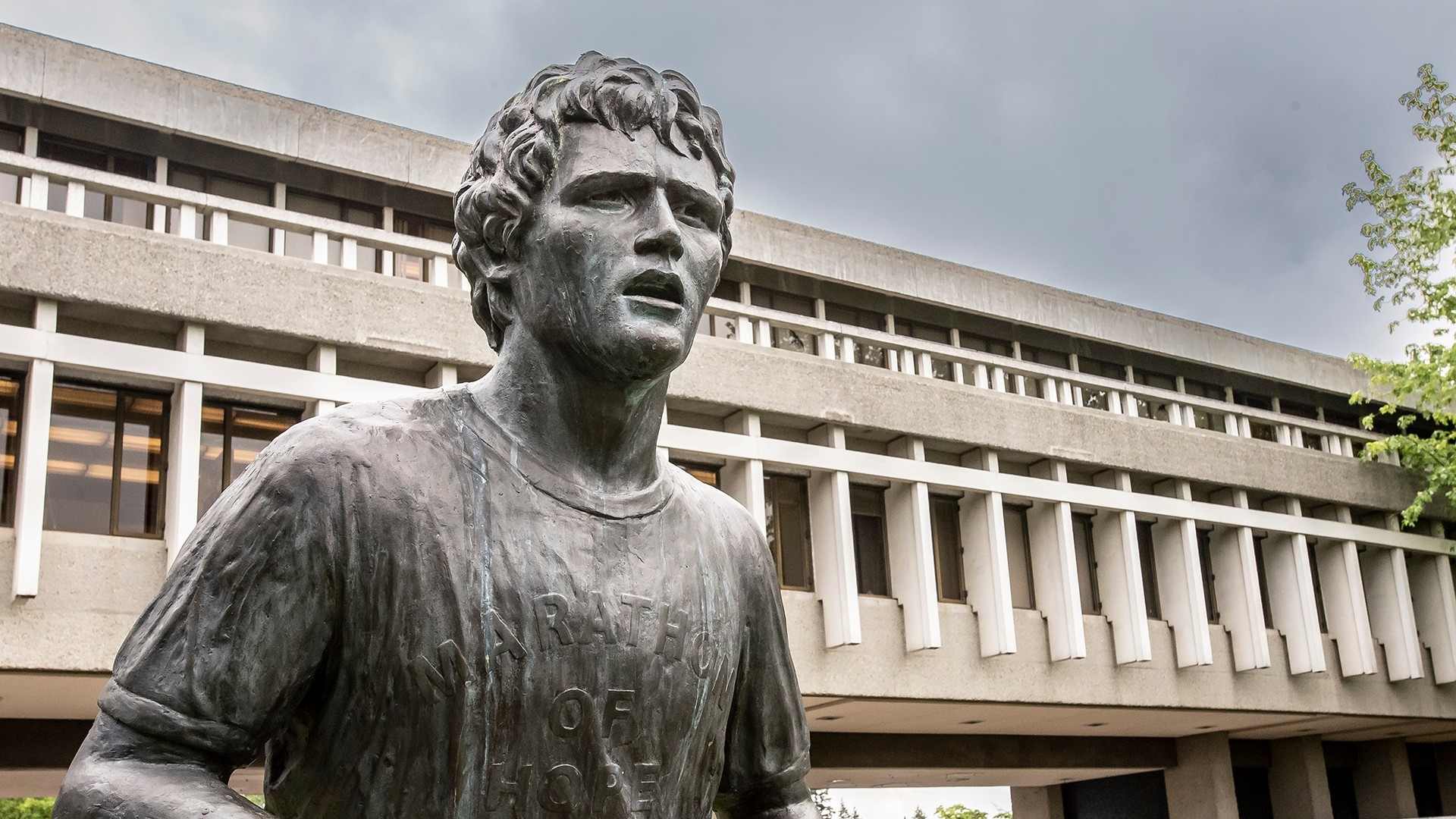
Terry Fox Statue at SFU

statue

President Stevenson and Betty Fox at Terry Fox statue unveiling at SFU in September 2001

divider

Terry Fox more than just a subject for sculptor

By Doug Ward, Vancouver Sun, Sept. 15, 2001

Note: This article was published in the Vancouver Sun newspaper on September 15, 2001.

Roberts Creek. It took sculptor Stephen Harman and his team five weeks of 18-hour days, seven days a week, to craft a larger-than-life bronze statue of a young man with an artificial right leg, wearing a T-shirt that reads Marathon of Hope.

And when Harman grew tired, or anxious about his task, he would take inspiration from the courage of his subject, Terry Fox.

"He's been the only true hero that I have. And every day, I thought about that", says artist Stephen Harman.

Standing outside his foundry in this bucolic sunshine Coast community, Harman recalled the laborious process of creating the $90,000 statue set to be unveiled next week at Fox's alma mater, Simon Fraser University.

Harman said he kept a video of the cancer victim's short but poignant life at his home in near-by Gibsons.

"I watched it so many times. If I felt tired, I watched it. When we were half-way done and I wondered how are we going to get through this, I would just watch the video and get inspired."

"The challenges he had to go through made the rest of this seem like nothing."

Harman, son of the late sculptor Jack Harman, worked with sculptor Geoff Jones and five other foundry employees to build the Fox statue, which will be formally installed Wednesday in the courtyard of SFU's academic quadrangle.

The unveiling of the 9 1/2 foot statue will mark SFU's first Terry Fox Day. The special day will occur every year on the Thursday following the annual Terry Fox runs, which are scheduled for this Sunday.

The Sunshine Coast foundry was started by Jack Harman, who crafted some of Vancouver's most familiar sculptures, including the Harry Jerome statue in Stanley Park and Roger Bannister running past John Landy on the Pacific National Exhibition grounds.

The creation of the Fox statue was lengthy and intense. Harman designed a small wax figure as a model and showed it to SFU's Lorne Davies and to Fox's parents for approval.

Harman and his team set to work in early July. Their first job was to build a steel skeleton to which nearly 900 pounds of wet clay was added. Rubber moulds were then taken from the clay. The work was done in pieces: the head, torso, the arms, the complete left leg and the artificial right leg.

The casting in bronze then began. Harman used a silicon bronze; an amalgam of copper and silicon. Once together, the statue was polished with glass bead, a refined kind of sandblasting, and then polished and stained to a light brown.

Harman, 35, said he and his team had the dual pressures of a short timeline and the expectation of their SFU clients for a representation of Fox that will endure.

"This is so much more than a job," said Harman. "For as long as people want to stand there, it's going to be there. It could be over a thousand years or more."

"And so we've got to do it right. It doesn't matter if we are tired."

Harman recalled being deeply affected by Fox's Marathon of Hope, “ the 1980 national trek to raise money for cancer research“ and the run's premature end and Fox's eventual death.

"I was 14 and I remember there was a telethon for Fox and I donated $25, which was a big deal at the time.

"I remember the press conference when he said the cancer had spread to his lungs and that he wouldn't be able to continue."

Harman said that Fox struck a chord in Canada, a country not known for honouring its heroes. "We're just not hero-worshippers in Canada. I think we are more subdued than the Americans when it comes to nationalism. We are more modest. So it really takes a pretty special person to become a Canadian hero."

Harman said that Fox's death preserved his heroic stature. "He was a kid, 20 years old. And the fact that he died meant he was never allowed to grow up and disappoint us. He could do no wrong."

Former SFU athletic director Lorne Davies said that Canada needs heroes like Fox. "We are relatively conservative and don't brag very much as a people. We have humility. And we have no Washingtons or Lincolns."

"But here was this young man who captured the hearts of Canadians by valiantly running across Canada. Not for any personal glory but to raise money for cancer research."

It was Davies who first proposed that a statue be built for SFU, which Fox attended and where he trained for his Marathon of Hope.


Terry Fox (July 28, 1958 - June 28, 1981)