

- Programs
- Students
- Research
- Giving
- About
- Events
- News
- REDIRECT ONLY
- Sea, Land and Sky Initiative
Archaeology
Heritage in panels: səlilwətaɬ (Tsleil-Waututh) artist bridges past and present in new innovative exhibit at the MAE
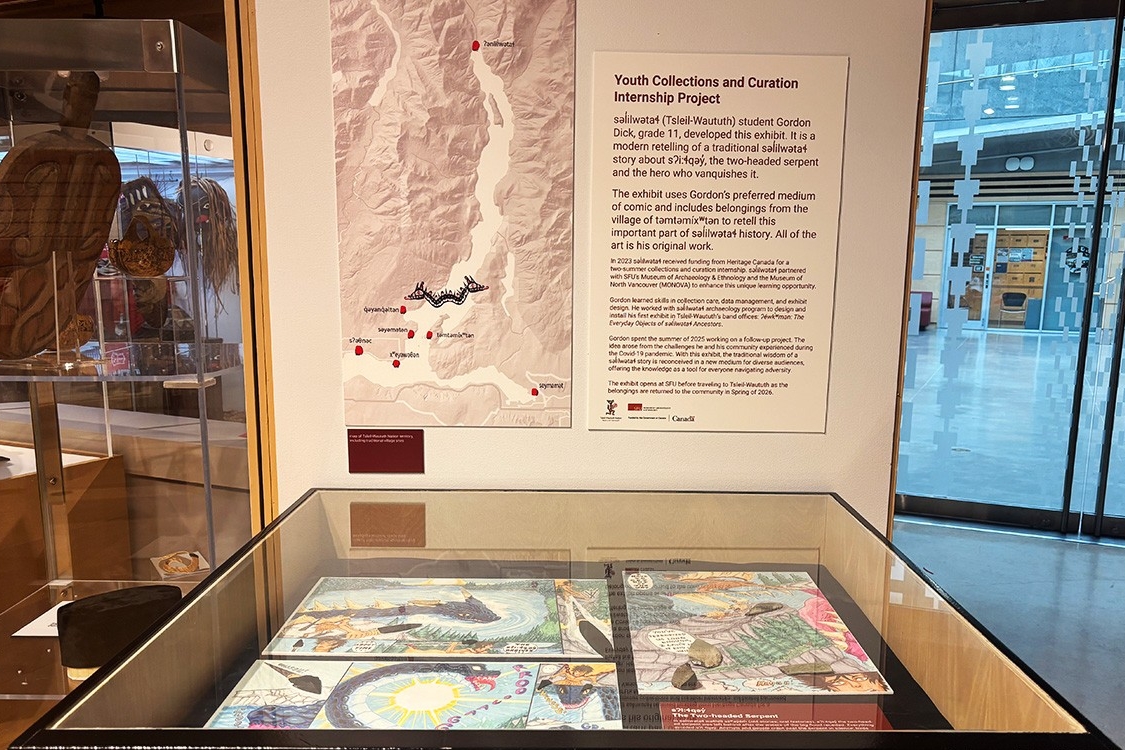
An epic story of perseverance in the face of adversity makes its debut at SFU’s Museum of Archaeology and Ethnology (MAE) this fall.
The new exhibit features 33 artifacts belonging to səlilwətaɬ (Tsleil-Waututh) Nation, superimposed on large comic book pages drawn in fine lines and bold colour by səlilwətaɬ artist and grade 11 student Gordie Dick.
Dick returned to the MAE over the summer for his second youth curation and collections internship, where he took on the project of developing a small exhibit of Nation belongings originating from təmtəmíxʷtən/Belcarra Regional Park.
“The Tsleil-Waututh Nation has been working on setting up a repatriation program for a few years, and through that process an archaeological repository,” explains Evan Hardy, senior repatriation and collections specialist with səlilwətaɬ.
Rather than move returned archaeological belongings in boxes from essentially one storage room to another, Hardy says they wanted to make them accessible to the community in a small exhibit space in their administration building.
In tandem with securing funding from Heritage Canada for this space, a youth internship program in partnership with the Museum of North Vancouver and the MAE also received funding to hire Dick, who spent time each week visiting both museums over two summers to learn how to do collections management and curate and design displays.
“We wanted to finish off the two-year internship experience with Gordie curating his own exhibit at SFU,” Hardy says.

In the exhibit, Dick frames the artifacts using the comic book genre as a modern vehicle to tell his favourite oral history — the story of sʔi:ɬqəy̓, the Two-headed Serpent.
The story goes like this:
A giant serpent with toxic blood, two heads and a deadly gaze terrorizes people and animals alike in the Burrard inlet.
Its long body separates two villages, ʔənlilwətaɬ (Inlailawatash) and təmtəmíxʷtən (Belcarra), isolating their communities and menacing those who need to hunt, fish and travel through the waters where it lurks.
“It was quite literally a natural disaster or a plague,” Dick explains.
However, the serpent meets its match in a young hero who confronts it wielding eight spears he crafted and imbued with a powerful medicine.
After its defeat, the serpent retreats over the mountains towards Port Moody, leaving a trail where vegetation no longer grows, and the two communities are once again united.
Over hundreds of years, the Two-headed Serpent has represented challenges the səlilwətaɬ community has faced, including war, famine and colonization.
The story of its vanquishing has continued to resonate as a one of resilience and tenacity during times of adversity.
“It’s about persevering through troubles you may have,” Dick shares, explaining that in the wake of Covid-19, he wanted to tell a story that resonated with those in his community that were impacted by the pandemic and felt isolated.

Dick selected the belongings used in the exhibit himself, which include an assortment of flakes, projectile points, blades, bifaces and antler fragments, an incised canine tooth and a core.
By integrating them into the drawings, he makes the story leap off the page.
In one panel, a sharp pin stands in for one of the spears. In another, flakes line the serpent’s back like scales. One particularly yellow point becomes the serpent’s large leering eye and projectile points replace the tips of the spears throughout.
“It's a radically different approach to curation,” MAE director Barbara Hilden says. “One I was thrilled to explore with Gordie.”

Comic-style artwork is Dick's preferred medium of expression. “It’s my way of telling a story,” he shares. Last year, he also did artwork for another exhibit, the first to be displayed in the Nation’s exhibit space, called ʔéwk̓ʷmən: The Everyday Objects of səl̓ilwətaɬ Ancestors.
On November 19th, a small gathering with members of Dick’s community and SFU’s Department of Archaeology came together in the MAE to celebrate the new exhibit.
The rest of SFU can come and see the story unfold for themselves in the MAE until the spring, when it will be relocated to the səlilwətaɬ Administrative Building and the belongings repatriated to the community.