

- About
- Research
- Prospective Students
- Current Students
- News & Events
- News
- Events
- News & Kudos Archives
- 2025 Archives
- Thesis Defence - Congratulations to Negin Shooraj
- SFU Geography Alumni Sean Orr wins Vancouver council seat in byelection
- Rosemary Collard awarded 2024 SFU Excellence in Teaching Award
- SFU Students Designed and Developed a GeoApp as a Living Wage Calculator
- Undergraduate students team secures third-place in Canada-wide GeoApp competition
- SFU Geography Wins Big at 2025 CAG Annual Conference
- Thesis Defence - Congratulations to Alex Sodeman
- Thesis Defence - Congratulations to Tintin Yang
- In Memory of Leonard "Len" Evenden, Professor Emeritus
- Gabrielle Wong awarded 2025 Gordon M. Shrum Medal
- Dr. Bright Addae awarded 2025 Graduate Dean's Convocation Medal
- Congratulations to Alysha van Duynhoven for Teaching Assistant Excellence Award
- Wildfires to waterways: SFU Geography grad takes action to protect the environment
- Making a difference on and off-campus: student leader and changemaker, Gabrielle Wong, awarded SFU convocation medal
- 2025 Alumni Newsletter
- Kira Sokolovskaia wins the 2025 SFU ECCE GIS Scholarship Award
- Mapping a path to City Hall: SFU alumnus shares journey to becoming Mayor of New Westminster
- Thesis Defence - Congratulations to Alysha van Duynhoven
- Thesis Defence - Congratulations to Hannah Harrison
- Thesis Defence - Congratulations to Jade Baird
- Thesis Defence - Congratulations to Ashley Tegart
- Rethinking the World Map: Dr. Shiv Balram featured on CBC
- Thesis Defence - Congratulations to Véronique Emond-Sioufi
- SFU Geographers at the 2025 International Cartographic Conference in Vancouver
- When academic curiosity meets environmental purpose: new global environmental systems grad builds interdisciplinary foundation at SFU
- Alysha Van Duynhoven wins the 2025 SFU ECCE in GIS Student Associate Achievement Award
- Thesis Defence - Congratulations to David Swanlund
- Congratulations to Our 2025 Warren Gill Award Recipients!
- Thesis Defence - Congratulations to Baharak Yousefi
- Thesis Defence - Congratulations to Tara Jankovic
- Thesis Defence - Congratulations to Christine Leclerc
- Thesis Defence - Congratulations to Kira Lamont
- Terri Evans: Researching homelessness in suburban communities
- Mapping change for people and the planet
- GIS Month: What is Geographic Information Science (GIS)?
- SFU GIS undergraduate develops real-time earthquake monitoring and hospital alert system
- Physical Geography student returns to SFU, dives into marine ecology, soils and GIS to map a new path forward
- SFU study searches Strava to reveal secrets to happier runs
- 2026 Archives
- SFU study searches Strava to reveal secrets to happier runs
- GIScience Students Become SFU’s First Team at National Geomatics Competition
- 2026 ESRI Canada GIS Scholarship for SFU
- Physical Geography student returns to SFU, dives into marine ecology, soils and GIS to map a new path forward
- SFU GIS undergraduate develops real-time earthquake monitoring and hospital alert system
- GIS Month: What is Geographic Information Science (GIS)?
- Mapping change for people and the planet
- GIS Team Crowned Champions of 2026 National Geomatics Competition
- Second-year MSc Student, Erin Fairley, has made it to the SFU 3MT Finals!
- Thesis Defence - Congratulations to Brandon Drucker
- In Memory of Ivor Winton
- SFU Students Create GeoApp to Reveal Transit Deserts and Oases Across Metro Vancouver
- Andrew Perkins receives 2025 Excellence in Teaching Award
- Krista Macaulay Receives Prestigious Trudeau Fellowship
- Human Geography Student Guneet Kaur Receives SFU Centre for Dialogue Award for Undergraduate Research
- Dr. Baharak Yousefi awarded 2026 Graduate Dean's Convocation Medal
- Thesis Defence - Congratulations to Scott Peters
- Gus Schiele wins the 2026 SFU ECCE GIS Scholarship Award
- GES grad maximizes interdisciplinary learning opportunities to tackle global challenges in conservation and sustainability
- Student Stories: Camille Dela Cruz
- Terrestrial ecosystem researcher joins SFU Geography
- Running dry: Cannabis farming is changing streams in California, experts warn
- Thesis Defence - Congratulations to Erin Fairley
- Thesis Defence - Congratulations to Lilian Yang
- Thesis Defence - Congratulations to Stella Harden
- Thesis Defence - Congratulations to Katie Gravestock
- Distinguished Professor Dr. Kirsten Zickfeld recieves highest national academic honour
- Thesis Defence - Congratulations to Babak Kasraei
- 2025 Archives
- Alumni
- GEOG 162 - Canada
- GIScience Labs

Research profile
I am a multi-disciplinary spatial visualization and spatial interface designer/developer/applied scientist in the Dept of Geography. I am a geographic information scientist with primary interests in 3D geographic visualization, 3D spatial interfaces, 3D data surveying, and applying these methods to real geographic challenges.
At the core of my research is the process of designing, developing and testing new geovisualization interfaces that respond to applied problems and challenges to characterize and understand the geometry and dynamics of complex spatial phenomena. My program of research is driven by how new enabling technologies facilitate powerful ways to characterize, visualize, experience and interact with geographic data.
I design, develop and deploy 3D geographic visualization, using augmented reality (AR), mixed reality (MR), extended reality (XR), , and immersive virtual reality (VR) systems. My work also involves the design of survey, capture, visualization and 3D analysis strategies, using laser scanning, structured light, photogrammetry, and structure-from-motion (SfM) methods.
I apply these technologies and techniques to respond to a wide range of spatial problems, including: climate change, sea level rise and adaptation; risk communication (tsunamis; earthquakes; mass evacuation simulations); coastal dynamics: coastal vulnerability; rapid-onset hazards; fluvial geomorphology; rigid-body slope mechanics; AI crowd simulations; 3D ecological monitoring on the seafloor (glass sponges); flood risk management in Canada; radiological exposure; digital cultural heritage and archaeological reconstruction; social justice; privacy and drone space analysis in 3D urban spaces; data processing, visualization and interfaces for off-world data, such as Mars.
Fields of interest
- Spatial interface research
- Mixed reality (MR)
- Augmented reality (AR)
- Extended reality (XR)
- Virtual reality and virtual environments (VR, VE) - Spatial computing (using physical spaces as experiential data visualization interfaces)
- 3D Geovisualization
- 3D GIScience
- 3D surveying and data collection
- Exploratory geomorphometry and archaeometry
- Critical theorization of interface-mediated information experiences, metaverses, cyborg theory,
- Telepresent interfaces
- Experiential information systems
Applied research themes
- Earth and space science informatics
- Climate change and climate futures visualization
- Environmental and ecological visualization
- Analytical archaeological geovisualization and interface development
- Geotechnical geovisualization and interface development
- Geovisual analysis and simulation of coronavirus
- Digital cultural heritage
- Social justice
Current Research Projects
Designing and developing 3D surveying infrastructure for ecological monitoring on the seafloor
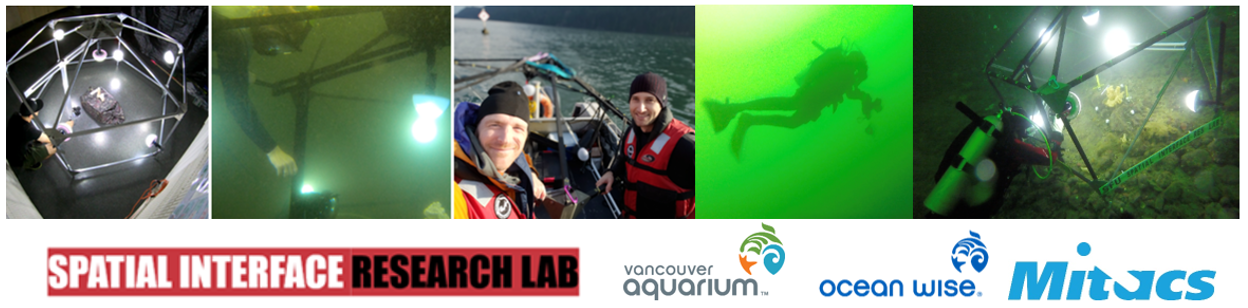
We designed, developed, and built an underwater rig that captures very high seafloor geomorphometry, for long-term ecological monitoring/eco-morphometry. The underwater rig was developed (in the dry) at SFU, and underwater in a large ocean-filled tank at DFO’s CAER research lab in West Vancouver. We developed empirical data science benchmarking protocols to assess the veracity of underwater photogrammetry, and successfully repeated deployment of complete, operational, benchmarked rig on the seafloor in Howe Sound, in support of Ocean Wise, Vancouver Aquarium, Coastal Ocean Research Institute (CORI). This work delivered new operational capability to our partners, and resulted in a new body of empirical research that establishes benchmarks for the data science of underwater surveying. This work was tweeted by SFU Research. See video:https://twitter.com/i/status/1063622899527892992
Experience-based design of scientific data visualization interface infrastructure
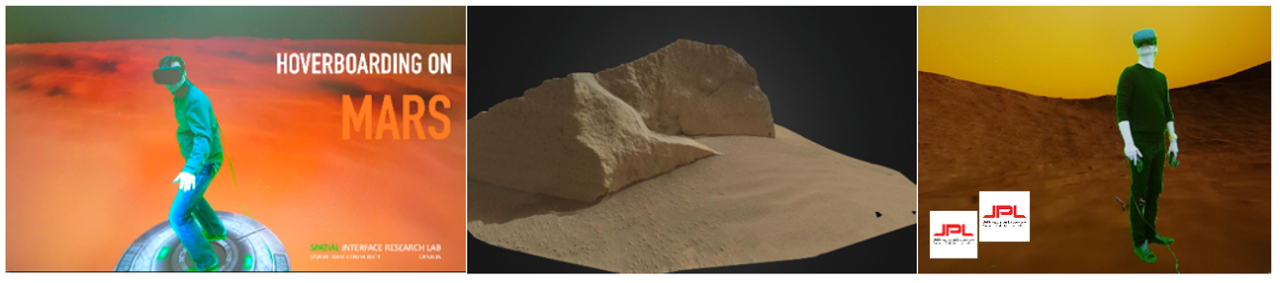
I am using the experience and insight of having designed/developed many 3D interfaces for many different spatial contexts – to inform the design and development of a new generation of scientific data visualization interface infrastructure at JPL. I am currently working on two vectors of this problem – exploring the scientific value proposition of emerging technologies across Earth and space science use cases; and developing the perceptual, cognitive and experiential design framework for integrating XR interface infrastructure for science data visualization into day-to-day science missions, in everyday lab spaces.
Developing analytical 3D tools for flood risk/policy visualization with Municipal Governments

I work with local governments (such as West Vancouver, City of Vancouver) on coastal geomorphometric surveys and analytical risk visualizations. I also explore the implementation of virtual and mixed reality GIS interfaces to support and enrich the way municipal planners, analysts and policy specialists use, and understand complex datasets. In particular to investigate their capability to enhance perception and analysis of structural data relationships in three-dimensional geographic space. We are evaluating their capability to support/enhance flood risk data visualization and use.
Using VR, AR and MR visualization technologies in social justice research
Using 360 VR, we are making it possible for anyone to participate in a walking tour hosted by social justice experts; using immersive VR and tabletop AR, we are allowing users to walk through historical spaces of xenophobia and incarceration, constructed using fire insurance and ownership records; in real-world spaces we are creating holographic reconstructions of families being rounded up – to connect ourselves to the history of this landscape, the people who have moved through it, and the social injustices they have endured.
Between Worlds – demonstrating the potential of XR interfaces for digital cultural heritage
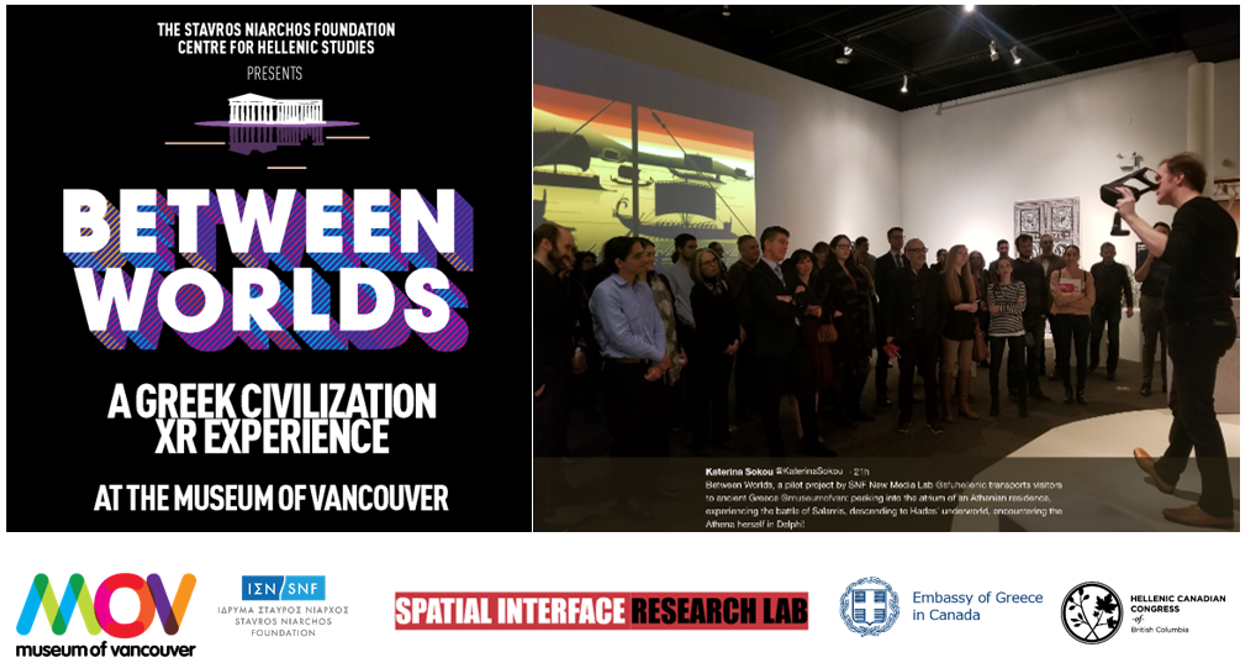
I designed and developed Between Worlds – a radical 3D interface-based exhibit, demonstrating a vision for future learning and engagement experiences with spatial data, geovisual experiences, digital cultural heritage. This work was funded by a grant from the Stavros Niarchos Foundation, and a partnership with the SNF Centre for Hellenic Studies, and the Museum of Vancouver. It demonstrates the potential and implications of transformative spatial information experiences in public education environments – using extended reality (XR), virtual reality (VR), mixed reality (MR), 3D data and simulation.
TV feature: https://youtu.be/OzDgtPuMMgo
Press/social media:
https://www.sfu.ca/hellenic-studies/newsroom/news/found-in-translation.html
For more information
See my research website: www.spatialinterfaceresearchlab.org
I welcome students interested in graduate research in all the areas noted above
Courses
Spring 2027
Future courses may be subject to change.