

- People
- Leadership & Staff
- Research faculty
- Gabriela Aceves-Sepúlveda
- Alissa N. Antle
- Sheelagh Carpendale
- Parmit Chilana
- Jon Corbett
- Steve DiPaola
- Halil Erhan
- Brian Fisher
- Marek Hatala
- Kate Hennessy
- Alireza Karduni
- Sylvain Moreno
- Carman Neustaedter
- Will Odom
- Philippe Pasquier
- Niranjan Rajah
- Bernhard Riecke
- Gillian Russell
- Thecla Schiphorst
- Chris Shaw
- Wolfgang Stuerzlinger
- Ron Wakkary
- Ö. Nilay Yalçin
- Palashi Vaghela
- Teaching faculty
- Emeritus
- Adjunct Faculty
- Alumni
- Work at SIAT
- Opportunities
- Research
- Programs
- Undergraduate
- Graduate
- Micro-credentials
- News & Events
- Spaces & Equipment
- StudioSIAT
- Media
- Showcase
- Showcase Submission Form
- Spring 2026 Project Showcase
- IAT 265 Louie's Sandwicheria
- IAT 265 Katana Master
- IAT 265 Supermarket Simulator
- IAT 312 Nightborder
- IAT 312 End of the World
- IAT 313 The Tavern
- IAT 343 Under Pressure
- IAT 343 Pot Bound
- IAT 343 WORLDS
- IAT 343 The Heist
- IAT 351 ReCallia
- IAT 355 Pokemon Cultural Relevance
- IAT 355 The Triad of Modern Cinema
- IAT 355 The Uneven Wave
- IAT 355 Delivered
- IAT 355 Dead Internet Theory
- IAT 355 Every AI Query Has a Carbon Cost
- IAT 355 Youtube Trending Analysis
- IAT 355 TikTok Vs Spotify
- IAT 355 Marbled Murrelet Habitat & Population in BC
- IAT 380 Charlotte Destivelle
- IAT 380 Lumi & Pip
- IAT 380 Selene the Low Rent Exorcist
- IAT 410 Witch's Winter
- IAT 410 Arcane Redemption
- IAT 410 AstrOh-No!
- IAT 410 Fantaseum
- IAT 445 Atom Viscera
- IAT 459 TrailTracker
- IAT 459 UniBazaar
- IAT 499 Beneath the Grey
- IAT 459 Mixtape
- Fall 2025 Project Showcase
- IAT 100 Onions on the Side
- IAT 100 LEGS
- IAT 100 Where is My Husband
- IAT 202 On the Line
- IAT 233 The Voronial Pavilion
- IAT 235 CMC Pet
- IAT 238 Jazzdor Festival Microsite
- IAT 265 Aquarium Life
- IAT 312 Greedy Goblins
- IAT 312 Take the Reins
- IAT 313 Hollow Sacrifice: A Dying World
- IAT 313 Sporefall: No One Left Behind
- IAT 313 The Innocent's Descent
- IAT 333 Mastercard Fraud Analysis Dashboard
- IAT 333 Vancouver Police Museum: Adaptive Mode
- IAT 334 Roominate
- IAT 334 Spotify Jam Feature Addition
- IAT 343 The Secret of the Skygarden
- IAT 343 Autoviscera
- IAT 343 We'll Be Right Back
- IAT 351 Moody
- IAT 351 Anchor Funds
- IAT 355 The Voyager
- IAT 355 The Housing Crisis
- IAT 359 Chemtrails: The All-in-One Travel Planner
- IAT 359 Consistency
- IAT 387 PhoenixRise
- IAT 445 Santa's Little Helper
- IAT 445 Something Lurking
- Spring 2025 Project Showcase
- Fall 2024 Project Showcase
- Summer 2024 Project Showcase
- Spring 2024 Project Showcase
- Fall 2023 Project Showcase
- Spring 2023 Project Showcase
- Fall 2022 Project Showcase
- Spring 2022 Project Showcase
- Fall 2021 Project Showcase
- Spring 2021 Project Showcase
- Fall 2020 Project Showcase
- Contact
- Staff & faculty resources
Research
Exploring Creative Artificial Intelligence
From the industrial revolution to the digital one, the ability to invent and use machines to automate tasks is a defining part of being human. In recent years, artificial intelligence (AI) and data-driven Machine Learning (ML) methods have been successful at automating a growing number of complex tasks in ways that outperform humans. But, can machines help us be creative or create by themselves for us?
Creative AI is the emerging field concerned with the use of AI and machine learning for the partial or complete automation of creative tasks. As a new field, Creative AI explores a number of intriguing questions:
- Can we understand and model human creativity?
- Can we discover creative processes that humans are not capable of?
- Can we generate interactive experiences and content tailored to a given user at a given time and over time?
- Can we challenge social and cultural ideas of AI through the making of artworks?
Creative AI is one of the fast-growing areas in emerging technology and offers new ways to empower people with that allow them to create better, faster, or differently. For example, if you are tired of clicking on buttons and menus one-by-one to get the results you want, then Creative AI systems might be for you.
For the last ten years, the Metacreation Lab has been at the forefront of research and practice in Creative AI. Research in the Metacreation Lab explores how various creative tasks can be automated and enriched. These tasks include music composition, sound design, video editing, audio/visual effect generation, 3D animation, choreography, and video games design.
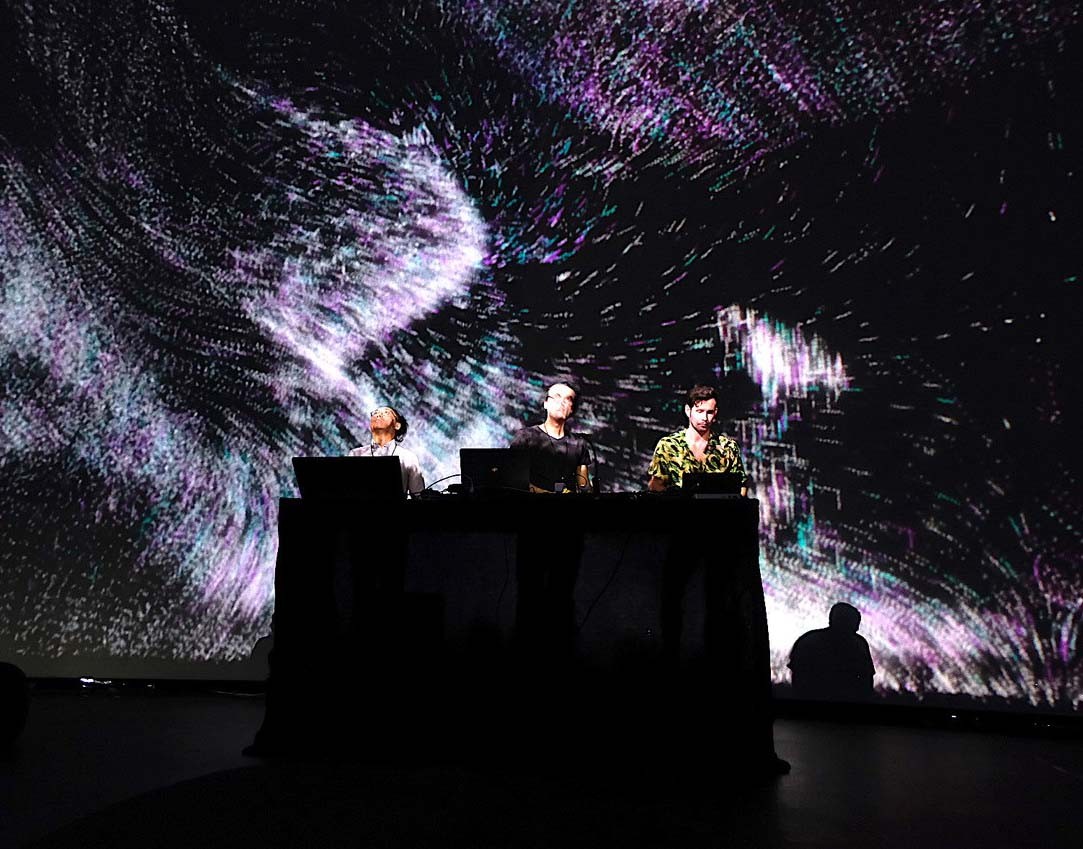
SIAT PhD candidate Kivanc Tatar, Remy Siu and Philippe Pasquier are playing live with the musical AI MASOM (Musical Agent based on Self Organized Maps) at the MUTEK Festival. This musical agent, based on neural networks, learns what type of sounds human use and how they sequence them by listening to a wide variety of music from dead composers, hence the name of the project: REVIVE (http://metacreation.net/revive/)
The Metacreation Lab has also developed creative applications in collaboration with companies such as Gener8, Ableton, or Teenage Engineering. These new applications have been used in performances and interactive artworks shown in prominent art museums, and festivals, including the National congress building of Romania, the Bolshoi theatre in Moscow (Russia), Ars Electronica (Austria), and the Olympic Games Cultural Program in Rio de Janeiro (Brazil).
More about the Metacreation Lab: http://metacreation.net/
More about Musical Metacreation (the international workshop): http://musicalmetacreation.org/
Photos credit: Ashley Gesner, 2018.