

- People
- Leadership & Staff
- Research faculty
- Gabriela Aceves-Sepúlveda
- Alissa N. Antle
- Sheelagh Carpendale
- Parmit Chilana
- Jon Corbett
- Steve DiPaola
- Halil Erhan
- Brian Fisher
- Marek Hatala
- Kate Hennessy
- Alireza Karduni
- Sylvain Moreno
- Carman Neustaedter
- Will Odom
- Philippe Pasquier
- Niranjan Rajah
- Bernhard Riecke
- Gillian Russell
- Thecla Schiphorst
- Chris Shaw
- Wolfgang Stuerzlinger
- Ron Wakkary
- Ö. Nilay Yalçin
- Palashi Vaghela
- Teaching faculty
- Emeritus
- Adjunct Faculty
- Alumni
- Work at SIAT
- Opportunities
- Research
- Programs
- News & Events
- Spaces & Equipment
- StudioSIAT
- Media
- Showcase
- Showcase Submission Form
- Spring 2025 Project Showcase
- Fall 2024 Project Showcase
- Summer 2024 Project Showcase
- Spring 2024 Project Showcase
- Fall 2023 Project Showcase
- Spring 2023 Project Showcase
- Fall 2022 Project Showcase
- Spring 2022 Project Showcase
- Fall 2021 Project Showcase
- Spring 2021 Project Showcase
- Fall 2020 Project Showcase
- Contact
- Staff & faculty resources
Research
SIAT graduate receives Best Canadian HCI Dissertation Award
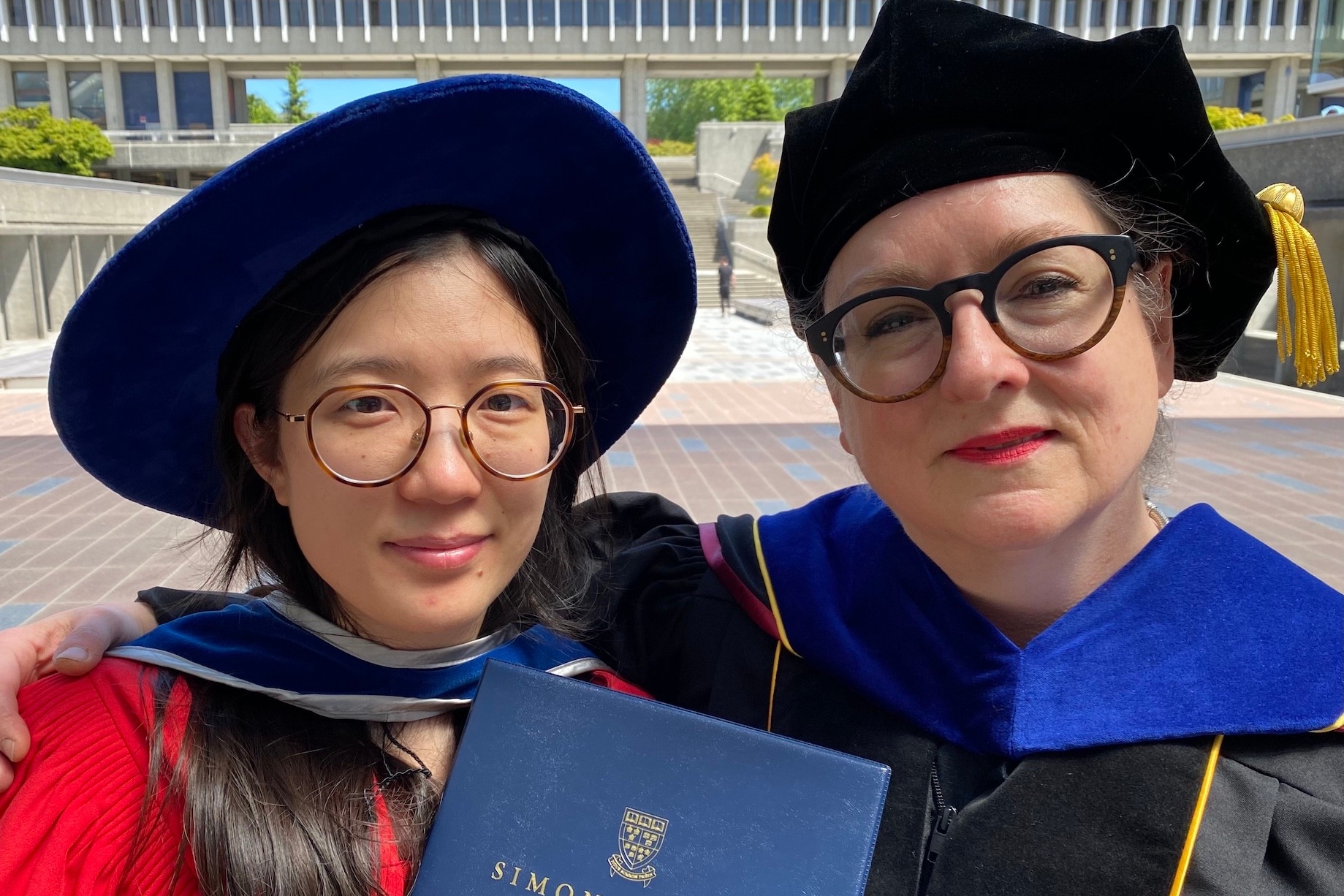
SIAT alum Dr. Xin Tong was recently awarded with the 2021 Bill Buxton Best Canadian HCI Dissertation Award.
The award is presented each year to the author of the most outstanding doctoral dissertation completed at a Canadian institution in the field of human-computer interaction (HCI) and was announced at the 2022 Graphics Interface conference that took place from May 17-19, 2022.
After completing a Master of Science at the School of Interactive Arts and Technology (SIAT) in the summer of 2015, Tong began her PhD studies under the supervision of Distinguished SFU professor Dr. Diane Gromala, professor Dr. Chris Shaw, and professor Dr. Dave Fracchia. She completed her award-winning PhD dissertation in the spring of 2021.
“I entered into this research domain primarily because of my supervisor, [SIAT professor] Dr. Diane Gromala and the projects I did in the Pain Studies Lab,” says Tong of her research in SIAT. “Her work inspired me a lot, and I’m impressed by how much we could do as researchers to resolve real-world challenges, particularly for pain patients and vulnerable populations.”
During her time at SIAT, Tong’s research largely centred on understanding, designing, and developing interactive systems, such as games and virtual reality (VR) environments, to support people’s physical, psychological, and social needs.
Her award-winning PhD dissertation “Bodily Resonance: Exploring the Effects of Virtual Embodiment on Pain Modulation and the Fostering of Empathy toward Pain Sufferers,” explores how immersive virtual reality can affect chronic pain patients’ perception of pain and how it can address the biological, psychological and social challenges that chronic pain patients face.
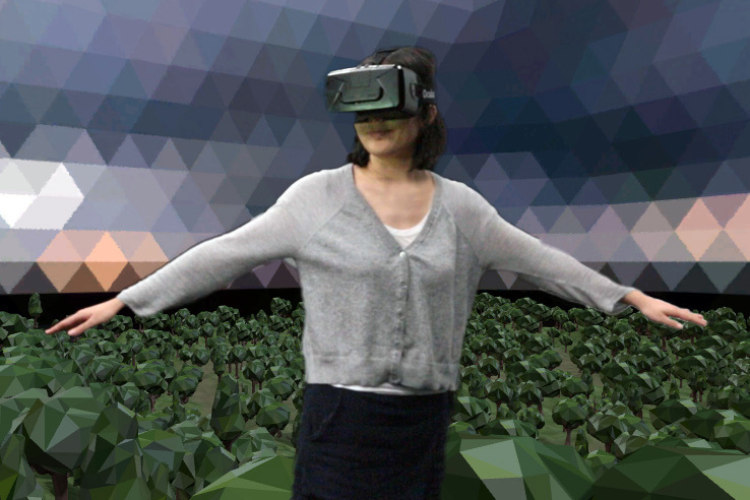
In her dissertation, Tong’s research examines, firstly, the analgesic effect that immersive virtual reality can have on chronic pain patients, and secondly, how VR could be used by healthy people to help foster empathy and reduce the social stigma surrounding chronic pain.
As part of her research in this area, Tong conducted three studies, including one exploring how an embodied virtual avatar (a virtual ‘body’ seen from a first-person perspective in VR) affected phantom limb pain perception.
Tong and her colleagues used VR to enable participants in the study to see both their intact hand and the phantom one virtually, with the phantom hand mirroring the movement of the intact one.
The study findings were very promising and suggested that VR sessions significantly reduced participants’ long-term phantom pain levels.
In fact, all three studies conducted by Tong indicated that when VR users see a healthy or intact virtual body or body parts, they experience significant reductions in self-reported pain.
After completing her dissertation and graduating from SIAT, Tong joined Stanford University’s Pervasive Wellbeing Technology Lab on an NSERC post-doctoral fellowship. There, Tong and researchers at the lab worked on projects that examined how the design and use of technology could be leveraged to better monitor and improve mental health and happiness.
Following her post-doctoral fellowship, Tong joined Duke Kunshan University, an international partnership of Duke University and Wuhan University, in the fall of 2021 as an Assistant Professor in Computation and Design.
Learn more about Tong's research and the award: